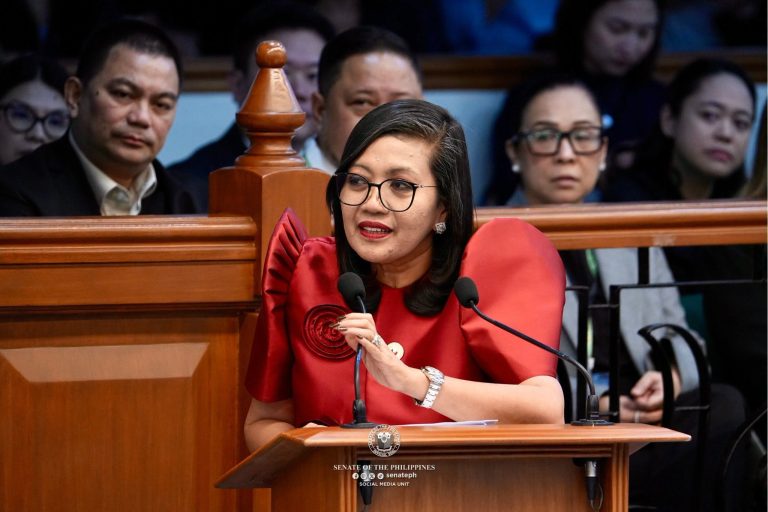
THE House Quad Comm is set to press former Palace official Irmina “Muking” Espino for answers at its upcoming hearing next week, following her Senate appearance where she denied involvement in an alleged cash reward scheme fueling the Duterte administration’s deadly drug war.
Quad Comm co-chair Santa Rosa City Rep. Dan Fernandez warned that Espino could face a contempt citation and arrest if she fails to appear at the joint panel’s Nov. 6 hearing.
“Most likely darating ‘yan kasi alam nya may procedure [ang Quad Comm]—una ay invitation, tapos show cause order, and then afterwards isa-cite in contempt,” Fernandez stated at a press briefing Tuesday.
Espino, identified by former Philippine Charity Sweepstakes Office (PCSO) General Manager Royina Garma as a staff of Sen. Christopher “Bong” Go, is accused of managing cash rewards distributed to police officers for killing drug suspects.
The Quad Comm has already issued a show cause order to Espino and five others named in Garma’s testimony, which claims a reward system was central to Duterte’s anti-drug operations.
The mega-panel directed Espino to explain why she should not be cited for contempt after she failed to attend the committee’s Oct. 22 hearing, despite a prior invitation.
Espino was previously reported to have worked with Go’s office at the Davao City Hall during Duterte’s tenure as mayor, later continuing with him at Malacañang as an Assistant Secretary when Go became Special Assistant to the President. She later served as Undersecretary until Duterte’s term ended in 2022.
Last Monday, Espino unexpectedly appeared at the Senate inquiry into the Duterte administration’s drug war.
She refuted claims of being a “disbursing officer” in the financial operations tied to the drug war, asserting that her role was limited to providing office supplies, equipment and gasoline to precinct commanders across Davao City.
Garma’s testimony confirmed suspicions that the Duterte administration’s drug war operated on a reward system incentivizing police to kill individuals on a so-called “drug list.”
The former PCSO chief provided a detailed view of this reward-driven operation, which fueled a deadly anti-drug campaign linked to thousands of extrajudicial killings and extensive human rights violations across the country during Duterte’s term.
She walked the Quad Comm through the campaign’s conception and execution, revealing that it was led under Duterte’s direct orders, with his trusted aide Go and retired Police Col. Edilberto Leonardo as allegedly key facilitators.
Garma explained that the nationwide campaign mirrored the Davao City model used during Duterte’s mayoral term.
She noted that officers received financial compensation only when suspects were killed, while arrests, though part of the operation, did not come with the same monetary reward.
Garma shared that cash rewards for drug-related killings ranged from P20,000 to P1 million, depending on the target.
Recalling the early days of the campaign, Garma said that shortly after Duterte’s election as president in May 2016, he asked her to find a police officer capable of implementing the war on drugs nationwide.
She recommended her upperclassman, Leonardo, who at the time was chief of the PNP’s Criminal Investigation and Detection Group (CIDG) in Region 11 and later became a central organizer in the campaign.
Upon taking on the role, Leonardo reportedly assembled a task force of operatives charged with gathering intelligence on drug suspects, verifying information, and managing police operations.
According to Garma, Leonardo established a system where rewards were dispensed for killings, with all reports and decisions routed through him.
A notable part of Garma’s testimony involved a figure named “Muking,” who allegedly managed financial aspects of the operation. It was later clarified that Garma was referring to Espino.
Garma said after she recommended Leonardo, Espino contacted her to request his contact details, which Garma then provided
Over time, Espino became a critical link in the flow of funds.
Garma learned from Peter Parungo, a “striker” in Leonardo’s office, that the large sums entering his bank accounts were linked to instructions from Espino.
Garma detailed how financial transactions for rewards were processed through Parungo’s accounts, who, though not a formal CIDG member, acted as the task force’s financial trustee, overseeing fund management.
About the Author