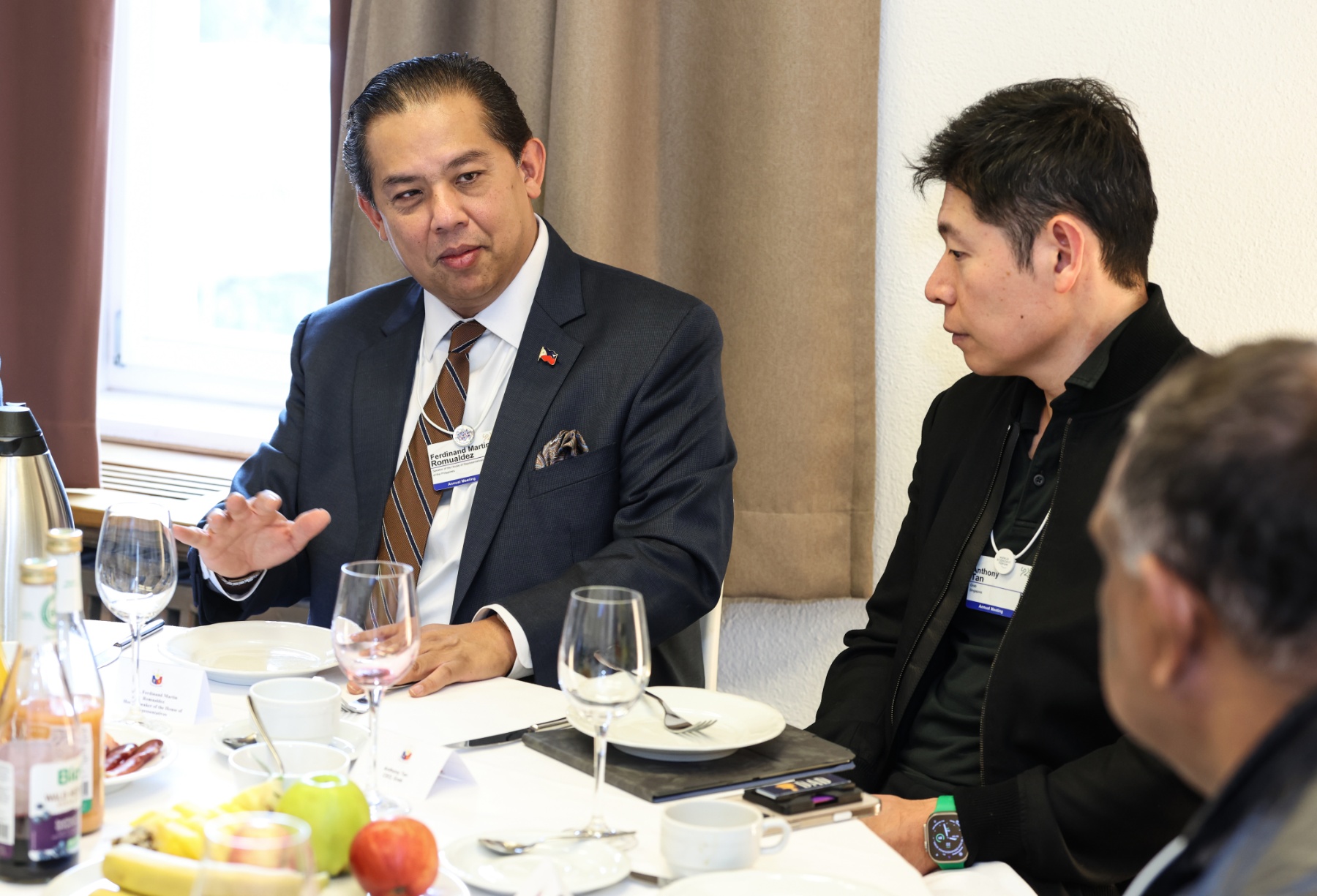
Speaker Ferdinand Martin G. Romualdez engages in a meaningful discussion with Grab CEO and co-founder Anthony Tan and other global business leaders invited for a breakfast interaction Wednesday (Switzerland time) at Hotel Belvedere in Davos, Switzerland with the Philippine delegates to the World Economic Forum 2025. In his message during the event, Speaker Romualdez underscored the commitment of the Philippine government to foster a more investor-friendly climate in the country. The dialogue centered on opportunities for investments in the Philippines, focusing on digital transformation, sustainable development, and public-private partnerships to accelerate economic growth.
SPEAKER Ferdinand Martin G. Romualdez on Wednesday (Switzerland time) underscored the Philippines’ dedication to fostering a truly business-friendly climate through sustained legislative and regulatory reforms.
He gave the assurance in his remarks during the breakfast interaction of the Philippine delegation to the 2025 World Economic Forum with top business executives in Davos, Switzerland.
During the event, Finance Secretary Ralph Recto gave a presentation highlighting the standout performance of the Philippine economy, marked by consistent and robust growth, along with ongoing initiatives to ensure such progress translates to more inclusive development.
“I wish to emphasize that a key objective of our engagement is to seek the private sector’s counsel and listen to your concerns,” Speaker Romualdez said.
“Our desire is to stimulate national development that will build durable partnerships and attract foreign investment, particularly through continued legislative and regulatory reform,” he added.
He cited the CREATE MORE (Corporate Recovery and Tax Incentives for Enterprises to Maximize Opportunities for Reinvigorating the Economy) law, signed by President Ferdinand R. Marcos, Jr. in November last year, as part of the administration’s reform agenda.
Speaker Romualdez explained that the CREATE MORE law is meant to accelerate investment momentum by offering enhanced tax incentives, streamlining the investment approval process, simplifying VAT rules, and providing targeted incentives for strategic investments.
“The CREATE MORE law is a clear manifestation of a positive feedback loop, where the current administration has committed to significantly rationalize the investment framework and create a truly business-friendly investment climate,” Speaker Romualdez said.
He said this initiative exemplifies the Philippines’ approach to economic policy—inclusive, adaptive, and anchored on strong collaboration between the government and the private sector.
Speaker Romualdez said that unlike other inward-looking economies, the Philippines is trying to advance a brand of nationalism that remains open and responsive to the global community.
The Speaker also showcased the Philippines’ robust economic trajectory, including a 5.5% GDP growth in 2023 and 5.8% growth for the first nine months of 2024—the second fastest in the ASEAN region.
Additionally, he noted that inflation has been successfully moderated to 3.2% in 2024, reflecting the government’s commitment to macroeconomic stability.
Speaker Romualdez also cited the establishment of the Maharlika Investment Corporation, the country’s first sovereign wealth fund, as a transformative step in catalyzing development and securing strategic investments in critical sectors such as energy security, digital infrastructure, agro-urbanism, and tourism infrastructure.
“We are cognizant that we cannot go it alone, so for this reason, an important objective for the Fund’s future is to pursue co-investments with the private sector, including foreign investors,” Speaker Romualdez said.
He said that sustainability remains a cornerstone of the Philippines’ economic agenda, noting that since the government’s decision in 2022 to allow full foreign ownership of renewable energy projects, the Philippines has approved 141 renewable energy projects valued at USD 70 billion.
Speaker Romualdez said these projects have been granted green lane access, further positioning the country as a leader in energy transition and investment.
As the Philippines prepares to assume the ASEAN Chairmanship in 2026, Speaker Romualdez expressed optimism about the nation’s future.
“Manila was once the fulcrum of global commerce through the Manila-Acapulco Galleon trade, and in 2026, we hope to continue to be a ‘BRIDGE’ in Building Resilient, Inclusive, Digital, Green Economies for all our partners,” he said.
“Rest assured, the government will continue its practice of multi-stakeholder engagement as we continue to adjust and refine our economic agenda,” he concluded.
About the Author