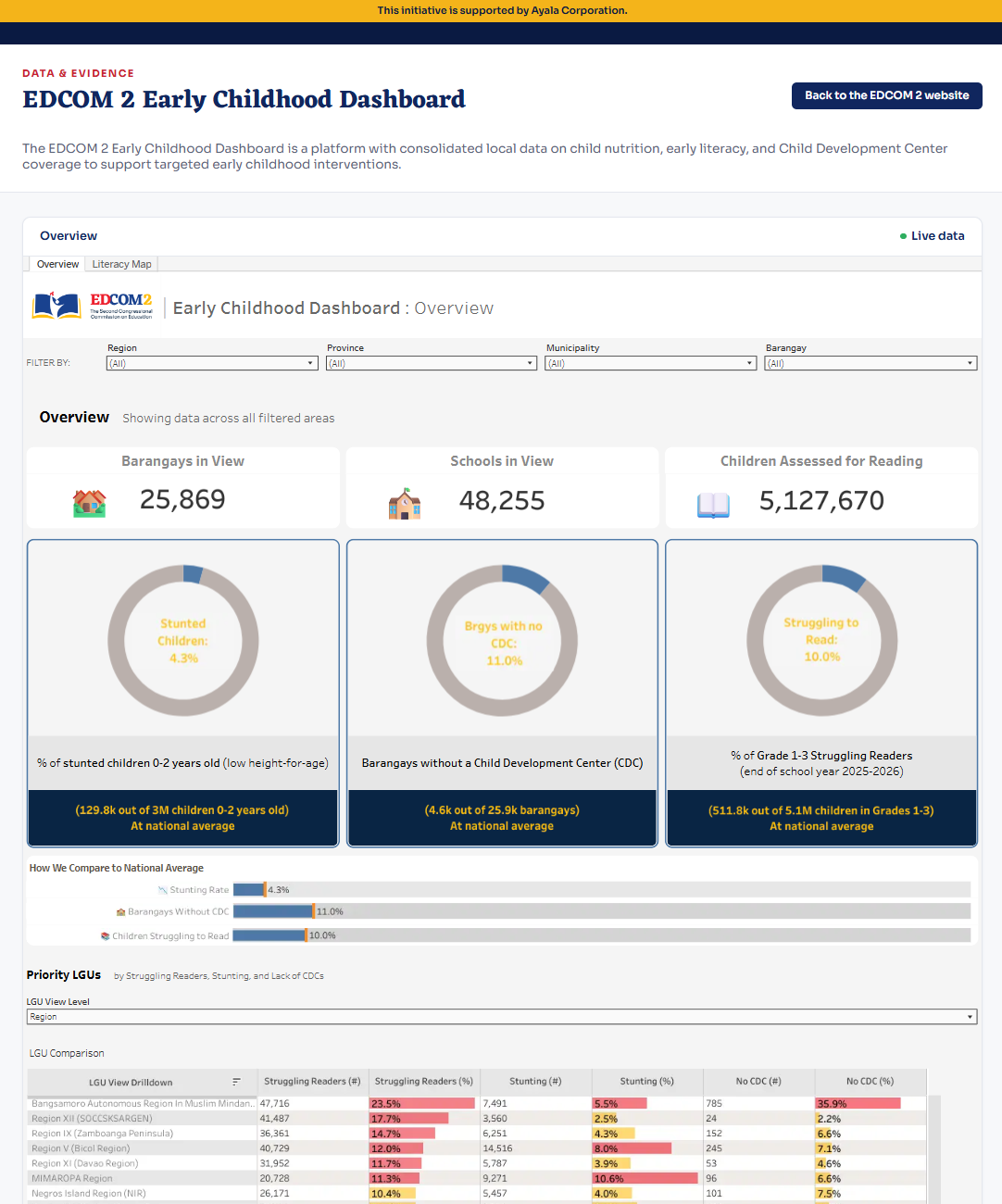
THE Second Congressional Commission on Education (EDCOM 2) has launched the Early Childhood Dashboard, a new digital platform aimed at empowering communities with the information to address foundational issues affecting Filipino children, and guide localized interventions in early childhood development.
“These are landmark initiatives that show our commitment to transparency in pushing for education reform,” EDCOM 2 Co-Chairperson Rep. Roman Romulo said.
“This platform embodies our belief that we must continue to strengthen transparency, because transparency enables collective action. And that information, when placed in the hands of people willing to act, can become a force for reform,” EDCOM 2 Executive Director Dr. Karol Mark Yee said.
The Early Childhood Dashboard was co-developed with AC Analytics, the Data Science and Artificial Intelligence team of Ayala Corporation. AC Analytics supports the AI transformation of the Ayala Group. It also provides assistance to various academic and government institutions in advancing data analytics and AI to support talent development, evidence-based policies, and AI-driven public goods.
The dashboard aims to guide local government units (LGUs), civil society organizations, schools, and other stakeholders in focusing their localized interventions in nutrition, early education, and reading for students in Kinder to Grade 3. The platform integrates three critical datasets from the National Nutrition Council, the Department of Interior and Local Government, and the Department of Education, to provide an accessible platform that fully captures the three connected foundations impacting child development.
First, it tracks the number and percentage of stunted children aged zero to two using data from Operation Timbang Plus 2025. Second, it utilizes the Community-Based Monitoring System to identify the specific barangays currently lacking a Child Development Center (CDC). Third, it maps the exact number and percentage of struggling readers in Grades 1 to 3 based on the Department of Education’s Comprehensive Rapid Literacy Assessment results from the end of School Year 2025–2026.
The dashboard currently accounts for 25,869 barangays, 48,255 schools, and 5,127,670 children assessed for reading. Nationwide, 4.3% of children aged 0–2 are stunted, 11% of barangays have no Child Development Centers, and 10% of Grades 1–3 learners are tagged as struggling readers as of the end of SY 2025–2026.
By presenting specific school-level data, the dashboard maps public schools to indicate the exact number and percentage of struggling readers, specifically identifying learners classified as low and high emerging readers. The ultimate goal highlighted by this data is to ensure all students are reading at grade level by Grade 3. The platform also directly compares local metrics against national averages, automatically turning text red when a local rate exceeds the national benchmark, thereby helping stakeholders quickly identify where early childhood outcomes require closer attention. Recognizing that nutrition, early childhood care, and literacy all shape the development of the same child, this comprehensive tool offers a common starting point for coordinated, localized action.
“This dashboard is not only a source of information. It gives LGUs, government agencies, civil society organizations, Church groups, companies, schools, and universities a common starting point for coordinated action,” EDCOM 2 External Engagements Lead Jude Liao said.
The public, local governments, and partner institutions can access the Early Childhood Dashboard at edcom2.gov.ph to identify priority areas for intervention and help ensure Filipino children receive the developmental support they need.
About the Author