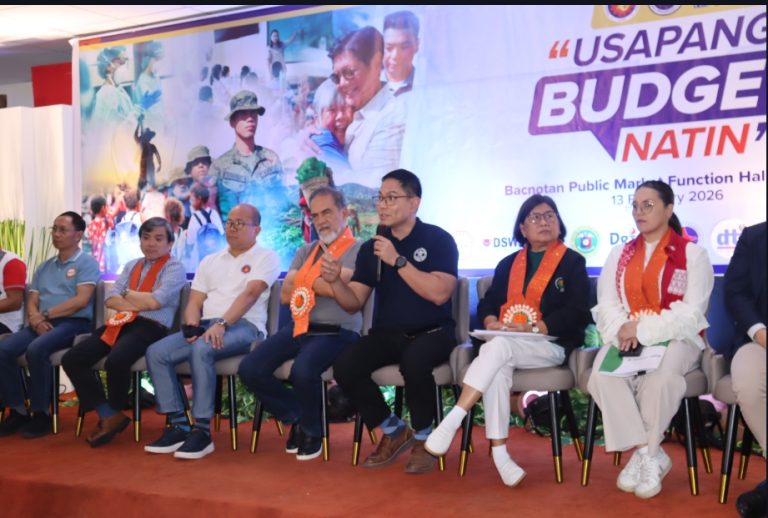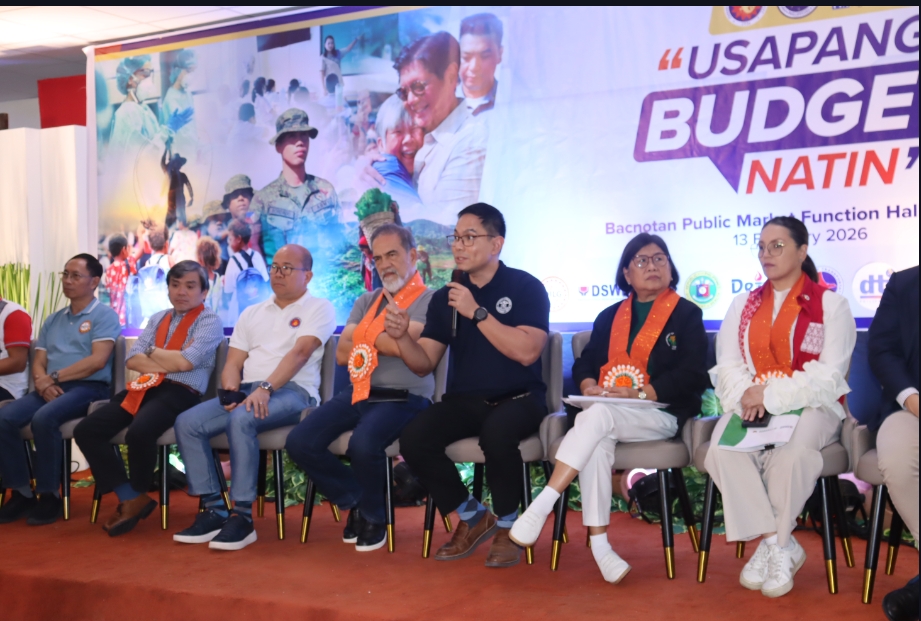
THE Department of Health (DOH) reaffirmed its commitment to transparency, accountability, and service expansion following the approval of its ₱448 billion 2026 national budget, a 73% increase during its 2025 budget with ₱706M allocated for DOH Region 1, during the “Usapang Budget Natin” forum held on February 13, 2026 at the Bacnotan Public Market Function Hall.
The public forum aimed to directly address community concerns on healthcare funding and ensure that taxpayers understand how government resources will translate into concrete health services on the ground.
Speaking before local leaders, market vendors, health workers, and civil society representatives, DOH Spokesperson Usec. Albert E. Domingo emphasized that the 2026 allocation will prioritize accessible, preventive, and patient-centered healthcare including the expansion of the Expanded Zero Balance Billing, establishment of more Bagong Urgent Care and Ambulatory Service (BUCAS) Centers, and Super Health Centers and conduct more PuroKalusugan activities in the communities.
“Ang 2026 budget ng DOH ay malinaw ang direksyon — mas maraming serbisyong medikal, mas malawak na Zero Balance Billing, at mas pinalapit na healthcare facilities para sa ating mga kababayan,” Usec. Domingo said. “Hindi lang ito dagdag na pondo; ito ay dagdag na serbisyo at konkretong benepisyo para sa bawat Pilipino.”
Domingo confirmed that a significant portion of the 2026 budget will strengthen the Zero Balance Billing (ZBB) Program, ensuring that indigent and financially vulnerable patients admitted in government hospitals will not pay out-of-pocket expenses beyond what is covered by PhilHealth and government subsidies.
“Layunin nating palawakin ang saklaw ng Zero Balance Billing upang mas marami pang pasyente ang makinabang, lalo na sa mga probinsya,” Domingo added. “Walang dapat mag-alala sa bayarin kapag ang usapan ay kalusugan.”
To decongest tertiary hospitals and bring services closer to communities, the DOH will accelerate the establishment of additional Bagong Urgent Care and Ambulatory Service (BUCAS) Centers and Super Health Centers, particularly in geographically isolated and disadvantaged areas (GIDAs) across Ilocos Region.
These facilities will provide urgent and ambulatory care, basic laboratory and diagnostic services, preventive and primary care consultations, maternal and child health services and non-communicable disease screening.
“Ang konsepto ng BUCAS at Super Health Centers ay simple — ilapit ang serbisyo bago pa lumala ang sakit,” Domingo explained. “Kapag maagapan, mas mababa ang gastos, mas mabilis ang paggaling, at mas kaunti ang nao-overwhelm na ospital.”
The P706M budget allocation for Region 1, will be use to prioritize in upgrading provincial and district hospitals, deploying additional health human resources, and expanding primary care infrastructure in remote municipalities.
Regional Director Paula Paz Sydiongco uemphasized that the region will implement strict monitoring and evaluation mechanisms to ensure optimal fund utilization.
“Ang bawat pisong inilaan sa DOH Region 1 ay may katumbas na serbisyo,” said Dr. Sydiongco. “Tututukan natin ang tamang procurement, tamang implementasyon, at tamang monitoring upang masiguro na ang pondo ay direktang napapakinabangan ng mga Ilokano.”
She further emphasized that improving healthcare access in far-flung barangays remains a regional priority. “Hindi dapat hadlang ang layo ng lugar para makatanggap ng dekalidad na serbisyong medikal. Sa pamamagitan ng mas maraming Super Health Centers at BUCAS facilities, mas magiging pantay ang access sa healthcare sa buong rehiyon.”
The DOH reiterated that the 2026 budget framework aligns with the Universal Health Care (UHC) mandate — shifting focus from hospital-centric care to a preventive, primary care-driven health system.
“Accountability is non-negotiable,” Domingo concluded. “May malinaw na targets, may performance indicators, at may transparency mechanisms. Ang pondo ng bayan ay para sa kalusugan ng bayan.”
The DOH encouraged the public to remain engaged, monitor implementation, and participate in community health consultations as part of its whole-of-society approach to health governance.
About the Author