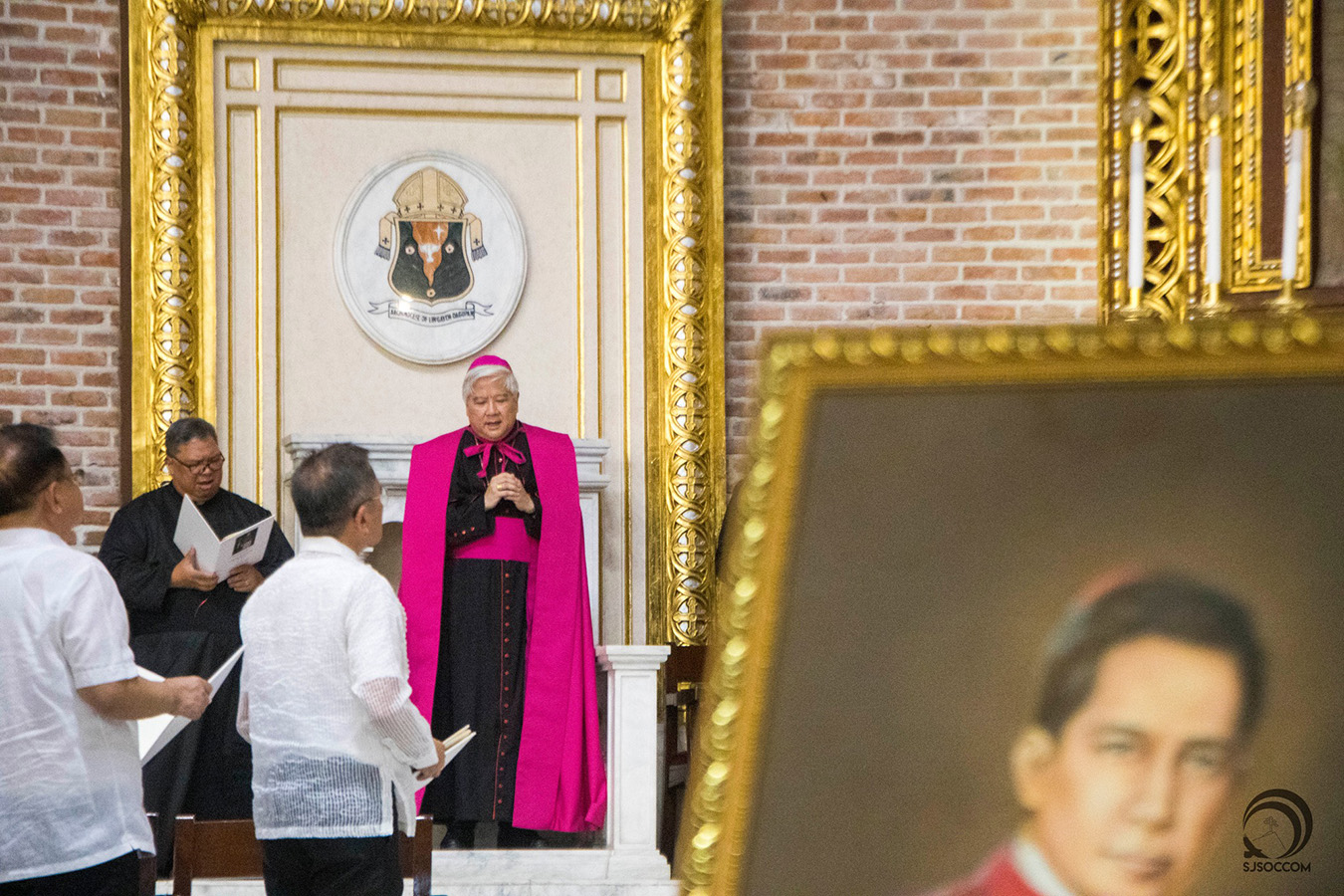
THE beatification cause for Bishop Cesar Maria Guerrero, the first shepherd of Lingayen, formally began March 27.
A Mass opening the diocesan phase of the cause was presided over by Archbishop Socrates Villegas of Lingayen-Dagupan at the Cathedral of St. John the Evangelist in Dagupan City.
The ceremony followed the Vatican’s issuance of a “nihil obstat” from the Dicastery for the Causes of Saints, indicating that the Vatican sees nothing standing in the way of advancing the cause for Guerrero.
“What a luminous twilight this is, as we begin the first steps that will hopefully lead to the canonization of the Servant of God, Bishop Cesar Maria Guerrero, our first bishop, whom his people hailed at his passing as sabio y santo, wise and holy,” Villegas said in his homily.
The Mass was concelebrated by Auxiliary Bishop Fidelis Layog and Bishop Renato Mayugba of Laoag, chairman of the CBCP Office of Postulation for the Causes of Saints.
With the diocesan phase underway, Guerrero is now officially referred to as a “Servant of God,” as a detailed documentation begins evaluating his heroic virtues.
The diocesan inquiry will also document any favors or miracles attributed to the bishop, alongside the establishment of a historical commission in line with canon law requirements.
Once the positio is submitted to the Dicastery for the Causes of Saints, the Vatican may recommend to the pope a decree declaring Guerrero “venerable.”
Beatification normally requires a verified posthumous miracle, while canonization usually requires a second. Success would formally recognize Guerrero as a saint of the Catholic Church.
The Vatican has recognized at least 22 causes from the Philippines, including three other bishops: Venerable Teofilo Camomot, Venerable Alfredo Obviar and Bishop Alfredo Verzosa.
Born Jan. 26, 1885, in Ermita, Manila, Guerrero earned a law degree from the University of Santo Tomas before pursuing the priesthood and studying at the Pontifical Gregorian University in Rome.
He was ordained Oct. 28, 1914, and returned to the Philippines the following year, serving in Binondo and as chaplain of the Hospicio de San Jose.
He went up the mountains for missionary work in San Mateo, Rizal, but this was cut short due to malaria. He was consequently appointed as secretary to Manila Archbishop Michael O’Dougherty.
Appointed the first bishop of Lingayen in 1929 by Pope Pius XI, Guerrero was consecrated May 24 by Archbishop O’Doherty. He founded a diocesan seminary in Binmaley, promoted clerical discipline, and advanced pastoral formation in the young diocese.
In 1937, he became auxiliary bishop of Manila and organized Catholic Action of the Philippines two years later, expanding lay participation in church life. After World War II, he faced accusations of collaboration with Japanese forces; the treason case was dismissed in 1946.
Guerrero was named the first bishop of San Fernando in 1949, promoting devotion to the Virgen de los Remedios, establishing a seminary, and supporting the Carmelite community in Angeles.
“Bishop Guerrero invites you: begin with Mary. In your homes and workplaces, let Remedios’ devotion quell your inner rebellions,” Villegas said.
Poor health led to Guerrero’s resignation in 1957. He retired to the Hospicio de San Jose, living a simple life of prayer and penance until his death on March 27, 1961. He was buried at the Carmelite monastery in Angeles City.
The Philippines has two canonized saints: Lorenzo Ruiz and Pedro Calungsod.
About the Author