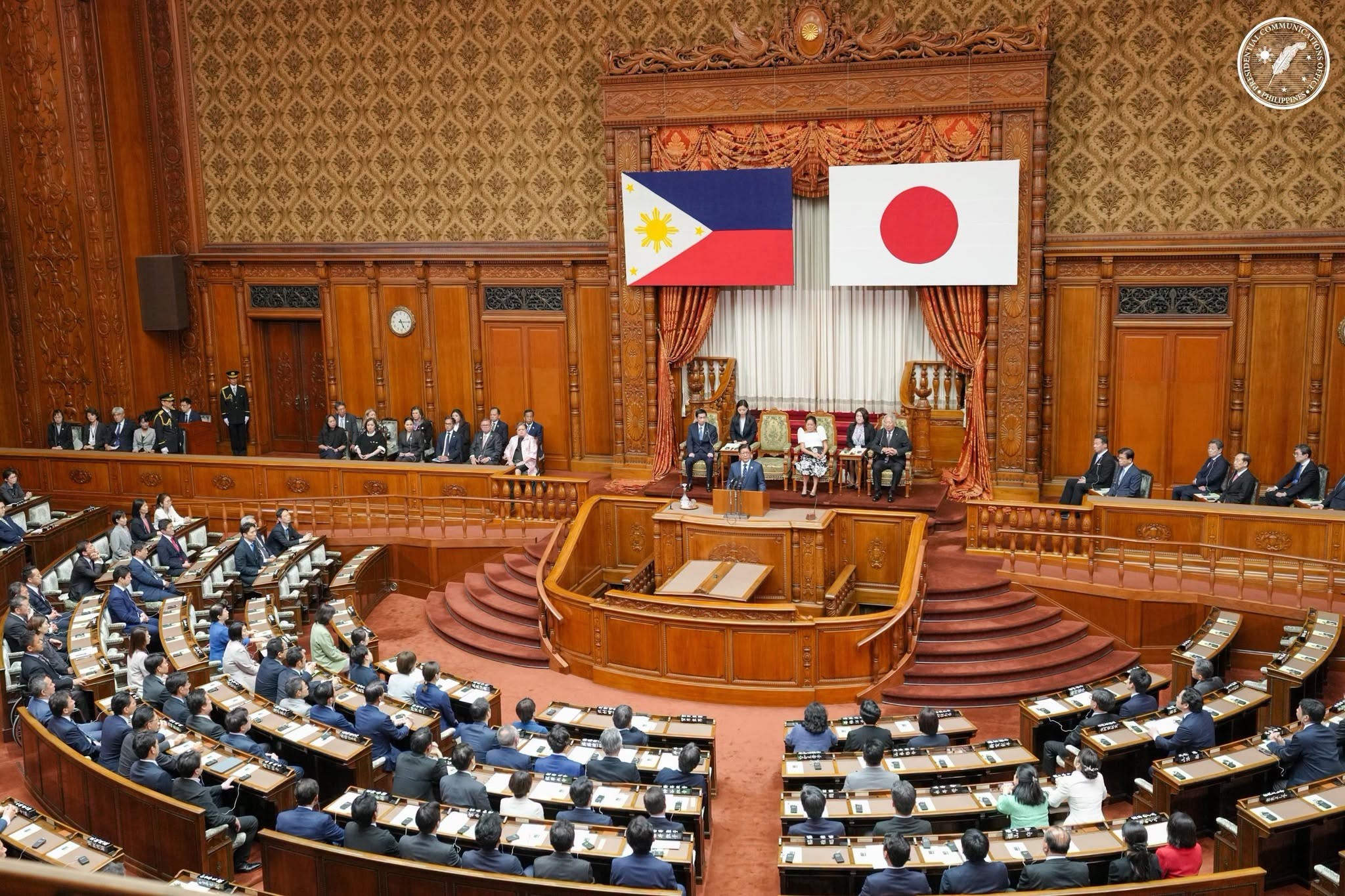
PRESIDENT Ferdinand R. Marcos Jr. on Friday concluded his four-day State Visit to Japan, which he described as “highly productive and constructive,” securing major economic, strategic, and diplomatic gains that further strengthened the Philippines’ partnership with one of its closest allies in the region.
Addressing members of the Philippine media delegation before returning home from Tokyo, President Marcos said the visit, which he undertook with First Lady Louise Araneta-Marcos and a delegation of government officials and business leaders, further strengthened the longstanding partnership between the Philippines and Japan as the two countries mark 70 years of diplomatic relations this year.
“It has been a very constructive and highly productive visit, considering that we are actually in Japan for just about three days…And yet in that little time, we were able to do a great deal,” President Marcos said during his regular “Kapihan with the Media”.
President Marcos said the timing of the State Visit was particularly meaningful as it provided an opportunity not only to reflect on seven decades of friendship between the two nations, but also to chart the future of bilateral relations.
One of the highlights of the visit was the President’s Imperial Audience with Emperor Naruhito and Empress Masako, which reaffirmed the enduring friendship and goodwill between the Filipino and Japanese people.
The President also held extensive discussions with Japanese Prime Minister Sanae Takaichi, where both leaders agreed to elevate Philippines-Japan relations from a Strengthened Strategic Partnership to a Comprehensive Strategic Partnership.
President Marcos said the elevated partnership reflects the growing depth and breadth of cooperation between the two countries across traditional and emerging sectors.
“This reflects how our cooperation has grown not only stronger but deeper and broader,” the President said.
Aside from security, maritime and defense cooperation, trade, and investment, the two countries also agreed to deepen collaboration in new and strategic areas such as energy security, supply chain resilience, decarbonization, artificial intelligence, and space cooperation.
President Marcos and Prime Minister Takaichi also exchanged views on pressing regional and global issues, including developments in the South China Sea and the Middle East, particularly their implications on regional stability and energy security.
The two leaders likewise reaffirmed their commitment to ASEAN unity and centrality, while Japan expressed support for the Philippines’ candidature to the United Nations Security Council.
During the visit, the Philippines and Japan signed several key agreements, including a landmark agreement on the avoidance of double taxation aimed at improving the business environment and encouraging greater cross-border investments.
Additional agreements covering agriculture and fisheries, health services, and human resource development were also signed.
In a significant development in defense and security cooperation, the Philippines and Japan formally announced the commencement of negotiations for a General Security of Military Information Agreement (GSOMIA) and maritime boundary delimitation.
“These initiatives will support our shared goals of security, economic growth, and resilience,” President Marcos said.
The President also underscored the substantial economic gains generated during the visit through meetings with Japanese business leaders and major corporations engaged in strategic and future-oriented industries.
Through a newly developed strategic engagement format, President Marcos met with some of Japan’s most influential business leaders representing sectors such as banking, infrastructure, aviation, manufacturing, telecommunications, mobility, renewable energy, healthcare, artificial intelligence, fintech, digital technology, tourism, and retail.
These engagements resulted in approximately US$3.4 billion worth of investment pledges, pipeline opportunities, financial support facilities, and tourism-related flagship investment prospects.
President Marcos also held separate meetings with executives of Furukawa Electric Corporation, Sumitomo Electric Industries, MinebeaMitsumi Inc., and Tsuneishi Group Corporation.
The companies presented expansion plans in the Philippines amounting to around PhP56.3 billion across semiconductor, advanced electronics, precision manufacturing, and shipbuilding industries.
These investments are expected to generate approximately 10,300 direct and indirect jobs for Filipinos.
“These engagements reaffirmed strong confidence in the Philippine economy and opened new opportunities for investments that will benefit our people,” the President said.
President Marcos also met with members of the Filipino community in Japan, where he recognized the contributions of the estimated 330,000 Filipinos living and working in the country.
The President assured overseas Filipinos that their welfare remains a top priority of the administration.
“Their hard work and dedication continue to strengthen the bond between our two countries,” the President said.
The President emphasized that Japan remains one of the Philippines’ most trusted partners and expressed confidence that the newly elevated Comprehensive Strategic Partnership would further deepen bilateral cooperation and bring meaningful benefits to both Filipinos and Japanese.
“As our relations with Japan reached new heights under a Comprehensive Strategic Partnership, I am confident that our cooperation will continue to deepen and broaden and will open new frontiers for the benefit of both our peoples,” President Marcos said
About the Author