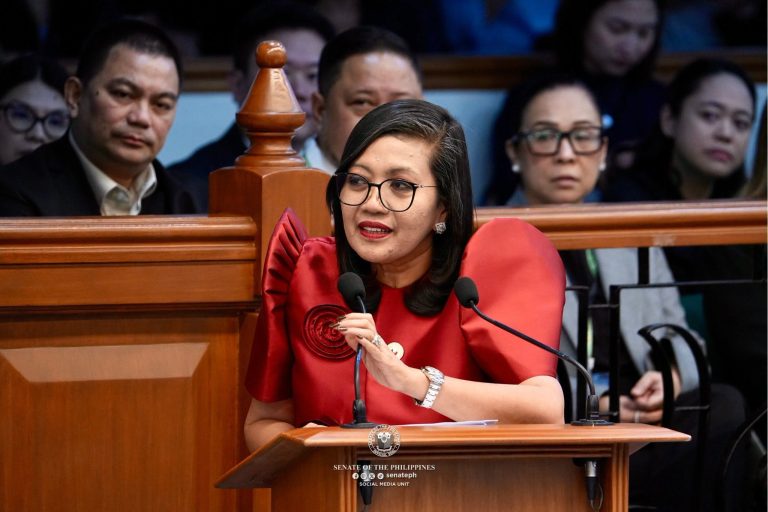
House of Representatives – Kamanggagawa Partylist Rep. Elijah “Eli” San Fernando on Wednesday pressed the Department of Labor and Employment (DOLE) and employer groups on the need to urgently review and overhaul the regional wage board system, calling the current set-up “illogical and unjust” for workers.
After the House Labor Committee approved House Resolution No. 232, urging the Regional Tripartite Wages and Productivity Boards (RTWPBs) to immediately act on pending wage hike petitions nationwide, San Fernando welcomed the measure as a necessary relief for workers. However, he underscored his continuing opposition to Republic Act 6727, the law that created the RTWPBs, arguing that the regionalized wage-fixing system is fundamentally flawed.
San Fernando argued that what was originally framed as a regional wage setting has even, in certain instances, turned into municipalized wages, with sharp disparities even between adjacent towns and cities where the cost of living is virtually the same.
“Hindi na nga regionalized wage fixing mechanism eh, municipalization of wages na ito. Saan ka nakakita, magkatabing munisipyo, poste o puno lang ang pagitan, pero magkaiba na agad ang sahod ng manggagawa?” San Fernando said.
He underscored that the system creates artificial barriers and perpetuates inequality, particularly in areas adjacent to Metro Manila, where workers essentially face the same living costs but are paid different wages by as much as P20 to P50 per day.
He cited several absurd examples of border towns and cities where crossing a single road, bridge, or landmark already means a sudden drop in wages. In Meycauayan and Valenzuela, only a pier separates the two, yet workers earn differently. In Bacoor, Cavite and Las Piñas, the Zapote Bridge marks the divide in pay. In Muntinlupa and San Pedro, Laguna, it is merely a Puregold store that separates wage rates. In Marikina and Antipolo, a single streetlight draws the line.
The Kamanggagawa lawmaker stressed that this setup is impossible to justify to ordinary workers. “How do you explain to a worker that their family’s needs change just because they crossed into another city? This is illogical and unjust. The cost of food, rent, electricity, and tuition does not magically drop when you cross into Cavite or Bulacan. Workers know this, and yet government policy insists otherwise. It is workers who suffer while employers take advantage.”
San Fernando also cited the presentation of Rep. Jolo Revilla, who highlighted official poverty threshold figures: in some regions, a family of five needs at least ₱13,000 to ₱15,000 a month just to meet basic food and non-food needs. Yet the minimum wage in many of these same regions remains far below this threshold.
“This confirms what workers have long said that the regional wage boards are not responsive to real conditions on the ground. If wages cannot even match the poverty threshold, then the system has already failed,” San Fernando stressed.
DOLE Usec. Felipe Egargo defended the wage boards, saying the agency merely implements RA 6727 as passed by Congress, and denied claims that the department consistently sides with employers. Egargo emphasized that the boards are fair as it is tripartite in composition, with two labor and two employer representatives, and that regional directors only preside over proceedings.
Employer Confederation of the Philippines (ECOP) Vice President Antonio Sayo, meanwhile, acknowledged the need for dialogue, expressing openness to further discussions on possible reforms. San Fernando welcomed this, noting that Kamanggagawa Partylist is ready to present its own models to demonstrate how reforming the wage system can benefit not only workers but businesses and the economy as a whole.
The Kamanggagawa Partylist lawmaker formally moved for the Labor Committee to include in its next meeting’s agenda the passage of a resolution to review RA 6727 and ensure that all stakeholders: labor groups, employers, and government are part of the discussions.
“We are not here to preserve a failed system. We are here to fix it. Wages must be fair, timely, and reflective of the real cost of living. Workers cannot wait another 36 years for justice,” San Fernando concluded.
About the Author