A FORMER constitutional commissioner on Tuesday said the framers of the 1987 Constitution did not intend to keep the document unamended for 37 years.
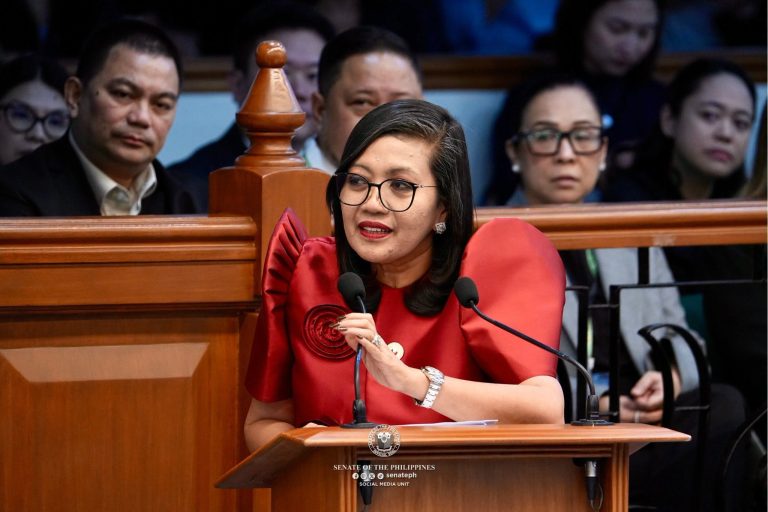
This was the disclosure of former Supreme Court Associate Justice Adolfo Azcuna, a member of the 1986 Constitutional Commission (ConCom) during interpellation by Gabriela Party-list Rep. Arlene Brosas on why the phrase “unless otherwise provided by Congress” was expunged in certain provisions in their deliberations.
The interpellation took place during the hearing of the committee of the whole last Tuesday relative to Resolution of Both Houses (RBH) No. 7, which seeks to amend Articles XII, XIV and XVI of the 1987 Constitution.
“Bakit hindi pinayagan yung ‘unless otherwise provided by Congress’ dati sa Constitutional Commission with regards to foreign ownership connected with the constitutional mandate for educational institutions?,” asked Brosas.
Azcuna said the ConCom did not want Congress to change the Constitution for at least five years to prove the effectiveness of its economic framework.
“We wanted no change by initiative. There’s a five-year period. We wanted the economic framework to work for at least five years. We did not expect it to be un-amended for 37 years. So ang time frame in mind, five years. After that, p’wede ng amendahin. Ang kaso nga hindi tayo nagkaroon ng amendment even on the economic provisions (of the Constitution) for 37 years,” Azcuna said.
He said the phrase “unless provided by law” should be included so that the Constitution can be changed by legislation.
“Originally, we did not want it to be changeable by legislation. But that was not our intention to do that for 37 years. As I said, we had a timeframe in our mind of maybe five years for these economic provisions to be unchanged. That’s why we did not want it then to be changeable so we did not want to put ‘unless provided by law’ on these economic restrictions at that time. It was a close voting. There were those who wanted it. But what prevailed was to maintain the economic restrictions without allowing Congress to change them. That’s why we have it in that form until now,” Azcuna explained.
Brosas pointed out that at one point of the ConCom proceedings, the constitutionalists even considered adding the sentence, “The Congress shall reduce the foreign equity.” She considered this as the ConCom’s way of emphasizing the importance of Filipino participation, “(I)t could never be reduced, but we can reduce the foreign equity.”
Azcuna affirmed the correctness of Brosas’ observation, “That is right. That was the thinking of the majority at that time,” before adding, “But these are economic policies and economic policies should not be frozen in time for a long period.”
He emphasized that the strictly nationalistic approach has to be modified to be able to meet current trends in the world economy while still trying to maintain an economy effectively controlled by Filipinos.
“I think that can be done and I think that’s why the present proposal is limited to three areas only of the economy to make sure that the entire economy remains in effective control of Filipinos,” Azcuna said.
Meanwhile, Azcuna explained that the RBH 7, which proposes amendments to certain economic provisions of the 1987 Constitution is limited by the very form and is subjected to the cardinal rule that only one subject matter must be expressed in the title.
“So as long as it is only RBH 6 of Senate and 7 of the House are the ones proposed and approved, then it will only be on economic provisions and specifically only on Articles XII, XIV and XVI,” he said.
Azcuna believes that the economic provisions should be flexible and the phrase, “unless otherwise provided by law,” is the best option, adding that economic provisions must be responsive to changes in economic conditions.
“The purpose and effect of such an amendment Mr. Chair is simply to make the provision to which it is attached, ‘unless otherwise provided by law,’ changeable by legislation,” he said.
He explained that the phrase simply operationalizes what the Constitution has already allowed, and that a law may be passed to provide a different arrangement that is pursuant to the power given to the Constitution itself.
Meanwhile, APEC Party-list Rep. Sergio Dagooc urged the National Economic Development Authority (NEDA) that there should already be studies available on which industries should be prioritized if the Constitution’s economic provisions are amended.
Parañaque City Rep. Gus Tambunting asked Undersecretary Rosemarie Edillon of the National Economic Development Authority, who replied, “we are looking to attract more strategic and high-quality foreign direct investments (FDIs), particularly in manufacturing, advertising — which can benefit the creative industries, and modern utilities such as electricity and high-speed telecommunications.”
About the Author