LEYTE 1st District Representative Ferdinand Martin G. Romualdez on Monday filed a landmark measure seeking to overhaul the country’s decades-old student subsidy framework by replacing the Expanded Government Assistance to Students and Teachers in Private Education (E-GASTPE) law with a more inclusive and adaptive voucher system.
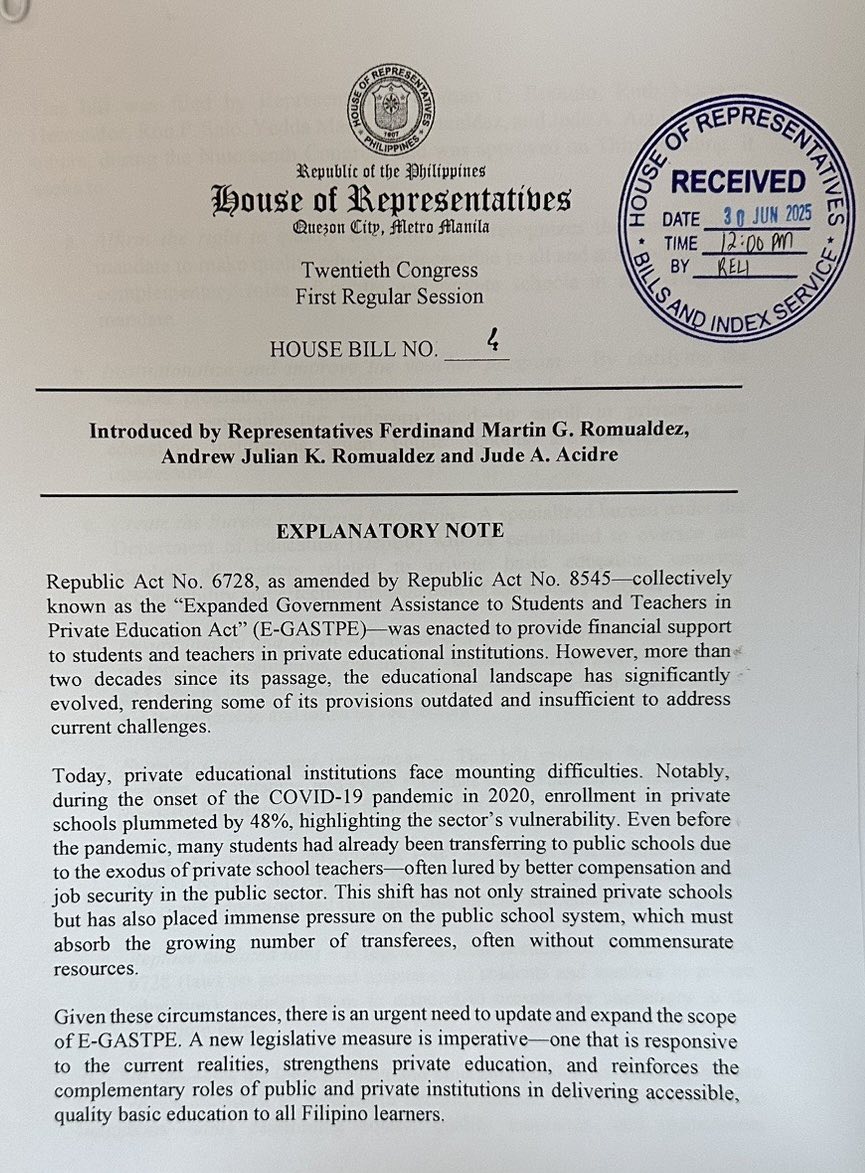
Filed at the opening of the 20th Congress, the proposed Private Basic Education Vouchers Assistance Act or House Bill (HB) No. 4 is among the first measures introduced by Rep. Martin Romualdez.
He is joined by co-authors Tingog Party-list Reps. Andrew Julian Romualdez and Jude A. Acidre.
The bill proposes the repeal of key provisions under Republic Acts (RA) Nos. 6728 and 8545, collectively known as the Expanded Government Assistance to Students and Teachers in Private Education (E-GASTPE) Act.
It also seeks the establishment of a new Bureau of Private Education under the Department of Education, which will oversee the implementation of voucher subsidies, teacher support programs and institutional development assistance for private schools.
“Hindi na akma sa panahon ang lumang E-GASTPE law. We are filing this bill to ensure that no Filipino learner is left behind, a principle enshrined under the Bagong Pilipinas campaign of President Ferdinand “Bongbong” Marcos Jr.,” Rep. Martin Romualdez said.
“This measure will strengthen our support to students who choose private schools, especially those in overcrowded or underserved areas,” he added.
The measure also aims to help private schools recover from mounting difficulties.
Notably, during the onset of the COVID-19 pandemic in 2020, enrollment in private schools plummeted by 48%, highlighting the sector’s vulnerability. Even before the pandemic, many students had already been transferring to public schools due to the exodus of private school teachers – often lured by better compensation and job security in the public sector,” according to the bill’s explanatory note.
“This shift has not only strained private schools but has also placed immense pressure on the public school system, which must absorb the growing number of transferees, often without commensurate resources. Given these circumstances, there is an urgent need to update and expand the scope of E-GASTPE,” it added.
Under the measure, qualified students from middle-income and underprivileged families will be granted government-issued vouchers to enroll in private basic education schools when public schools in their area are either congested or unavailable.
The amount of the voucher will vary depending on the student’s economic background, with priority support extended to the poorest sectors.
“Itong voucher system na ito, hindi lang ito para makalipat ng eskwela ang bata. This is about expanding choices, empowering families and fixing the imbalance in our education system,” Speaker Romualdez said.
Private schools may participate in the program through a recognition process and must submit to periodic quality assessments based on student outcomes, teacher development and institutional readiness.
Schools in conflict-affected or geographically isolated areas with limited resources will be granted flexible conditions for participation.
The bill also includes a Teachers’ Salary Subsidy Fund and an In-Service Training Fund to support teacher retention and development in the private sector, a response to years of attrition as many private school teachers have shifted to better-paying jobs in public schools.
“This is also a labor issue. Hindi natin pwedeng pabayaan ang mga guro sa private schools. Kapag nawala sila, damay pati ang mga batang umaasa sa kanila,” Rep. Martin Romualdez said.
To ensure effective governance, the Bureau of Private Education will serve as the focal office for all private basic education matters, including monitoring of voucher use, school performance and compliance with DepEd policies.
A new inter-agency Basic Education Assistance Council composed of DepEd, DBM and NEDA will provide strategic oversight.
The bill also mandates the publication of a public registry of participating schools, including tuition rates, classroom size, available slots and extracurricular offerings, allowing parents to make informed decisions.
“The goal is transparency and equity. Families should know what they are getting into, and schools should be held to account,” he said.
In addition to student vouchers, the measure empowers DepEd to offer school-level assistance such as support for facilities, curriculum development and teacher training, ensuring that private institutions remain viable and competitive.
“First and foremost, this is an education reform bill. But it is also an act of national solidarity. Kapag lumakas ang private schools, gagaan din ang pasanin ng public school system. Ang mananalo dito ay ang batang Pilipino,” Rep. Martin Romualdez said.
About the Author