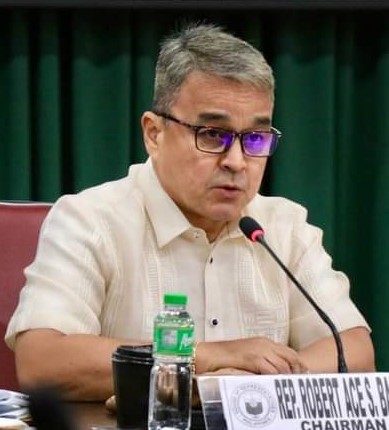
SURIGAO del Norte Rep. Robert Ace Barbers has filed a bill that would compel all law enforcement officers to promptly destroy all dangerous drugs seized during anti-drug operations to resolve the perennial problem of drug pilferage and recycling into the illicit market.
The solon from Mindanao said House Bill No. 9668 would mandate all incineration facilities, including crematoriums, to render free services for the prompt destruction of all illegal substances, particularly shabu, seized during anti-drug operations.
Barbers, chairman of the House Committee on Dangerous Drugs, said the lack of dedicated incineration facilities for the immediate destruction of all seized drugs had been a long-time concern since these substances are temptations for pilferage and recycling if held in custody for a long time by law enforcers.
“Kung maisasa-batas natin ito, mapipigilan na natin and pilferage at recycling ng illegal na droga at wala ng dahilan ang ating mga anti-drug agents na tumagal pa sa kanilang kustodya ang anumang illegal na droga na kanilang nakumpiska,” he said.
At the heart of said legislative proposal, Barbers said, is the concept of corporate social responsibility (CSR) on the part of incineration facilities, including crematoriums – which are traditionally associated with the dignified handling of end-of-life rituals – by extending their commitment to societal well-being.
“Kung maipapagamit sa atin ng libre ang mga incineration at cremation facilities para sunugin agad-agad ang mga kumpiskadong droga, maiiwasan na ang drug pilferage at recycling na matagal nang kinakaharap ng ating lipunan,” he said.
In return, Barbers said, any incineration or crematorium facility that would render services under the measure would be given tax incentives, entitling them to a tax credit of 10 percent but not exceeding P50,000 of the taxable gross income for a period of two years.
“Failure or refusal to render free destruction of any seized illegal drugs by the concerned facilities would be a ground for the suspension, revocation, or non-renewal of license or permit to operate said business/es,” he said.
Under the Bill, to be known as “Prompt Dangerous Drugs Destruction Act of 2023,” the Philippine Drug Enforcement Agency (PDEA) shall be the agency that would designate the cremation facility that would undertake the drug destruction process, giving preference to the facility nearest to the court having jurisdiction over the case or to the place where the dangerous drugs were seized.
“The destruction and disposal of seized or confiscated illegal drugs and other substances shall be done through a Court order and the same shall be conducted with the strict supervision of the PDEA,” Barbers said.
Under the Bill, the actual drugs destruction would be witnessed by 1. A PDEA personnel, 2. An elected public official, preferably the one who witnessed the physical inventory of the seized drugs, 3. A representative from the National Prosecution Service, 4. A representative from the media, and 5. A representative from civil society groups.
The PDEA would be in charge in the recording of actual destruction of the seized drugs; the issuance of certification indicating the brief summary of the proceedings, the witnesses present, quantity of items destroyed to be submitted to the court; and keeping of records together with owners and managers of incineration or crematorium facilities.
For its part, the Department of Environment and Natural Resources (DENR) will be tasked to issue pertinent guidelines and practices promoting anti-pollution measures in relation to the drug incineration and disposal.
About the Author