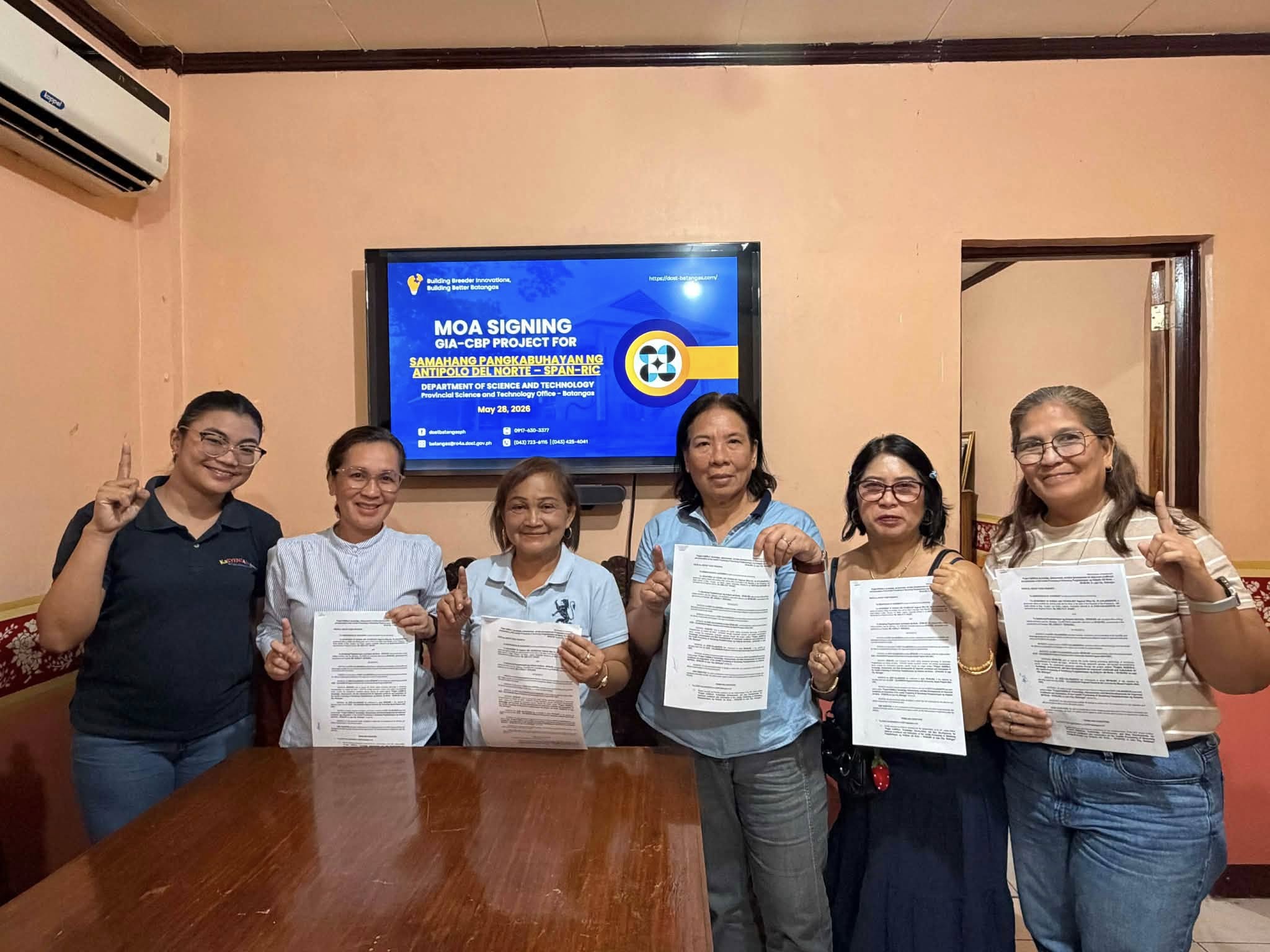
A women-led livelihood group in Lipa City is set to double its candle production capacity after the Department of Science and Technology (DOST)-Batangas formalized a partnership for a technology-driven candle processing project aimed at improving productivity, product quality, and income opportunities for its members held at the DOST-Batangas Provincial Office in Kumintang Ilaya, Batangas City, on May 28, 2026.
The DOST-Batangas and Samahang Pangkabuhayan ng Antipolo del Norte (SPAN-RIC) signed a Memorandum of Agreement for the implementation of the Grants-in-Aid Community-Based Project titled “Project KANDILA: Knowledge, Advancement, and New Developments for Improved Livelihood and Automation of the Candle Processing of Samahang Pangkabuhayan ng Antipolo del Norte – SPAN-RIC in Lipa City, Batangas.”
Representing SPAN-RIC during the signing was Ms. Aurea P. Vergara, while Engr. Lorelie A. Villa Del Rey, Lipa City Agriculturist, witnessed the ceremony. Ms. Felina C. Malabanan, Provincial S&T Director, signed the agreement on behalf of DOST.
With a total project cost of Php 335,000.00, the initiative will provide customized candle- making machines designed to modernize and improve the group’s production process.
Project KANDILA aims to strengthen the organization’s candle-making enterprise through equipment upgrading, process improvement, and product standardization to help increase production efficiency and market competitiveness.
Specifically, the project targets a 100 percent increase in production capacity and a 20 percent increase in sales within the first year of implementation. The initiative also seeks to help the association develop new candle variants that can cater to niche and emerging markets.
Beyond equipment support, the project will also capacitate at least 20 production workers and members of SPAN-RIC through training on candle-making technologies developed by the DOST Industrial Technology Development Institute.
The project highlights how science, technology, and innovation can help community-based organizations transition from labor-intensive production to more efficient and standardized operations, allowing small livelihood groups to improve income opportunities and strengthen sustainability.
About the Author