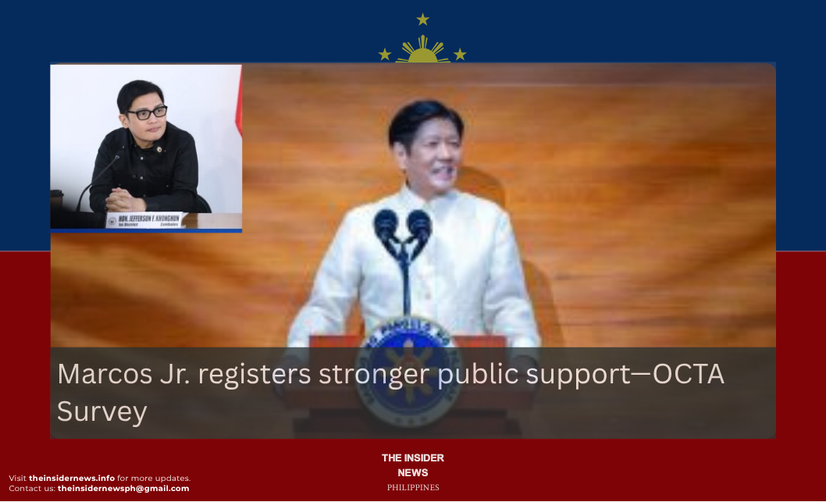
DEPUTY Speaker Jay Khonghun of Zambales said the latest Tugon ng Masa survey by OCTA Research shows rising public confidence in Ferdinand “Bongbong” R. Marcos Jr. as he enters the second quarter of 2026, reflecting what he described as a renewed trust in the President’s leadership amid ongoing challenges.
Khonghun pointed to the Q1 2026 poll, which showed Marcos gaining in both trust and performance while public uncertainty around him declined.
“Malinaw ang sinasabi ng numero. Habang maingay ang pulitika at magulo ang mundo, mas dumarami ang Pilipinong nagsasabing may direksyon ang Pangulo,” Khonghun said.
“Hindi ito sympathy vote. Hindi ito palakpakan lang. Ito ay pagtaas ng tiwala at pagtaas ng performance rating sa panahon na mahirap manalo sa isip ng publiko,” Khonghun said.
Released on April 21, the OCTA report found Marcos’ trust rating rising to 54 percent in the first quarter of 2026 from 48 percent in the fourth quarter of 2025.
His performance rating also climbed to 55 percent from 51 percent in the previous quarter.
OCTA described the shift as a rebound in both trust and performance, accompanied by declining ambivalence, and said this may point to a consolidation and stronger alignment in how the public views the President’s leadership.
The survey was conducted nationwide from March 19 to 25, 2026 through face-to-face interviews with 1,200 respondents aged 18 and above.
OCTA said the poll carries a national margin of error of ±3 percent at a 95 percent confidence level, while subnational estimates for NCR, Balance Luzon, Visayas, and Mindanao carry margins of error of ±6 percent.
The report also placed the survey period in a tense setting, citing the early stages of the Middle East conflict, emerging geopolitical and economic uncertainties, and domestic political developments, including the impeachment process involving the Vice President.
Khonghun said the most important part of the OCTA findings is not only the rise in Marcos’ ratings, but also the pattern behind it.
OCTA’s own summary said the quarter showed “diverging public sentiment,” with Marcos posting gains in both trust and performance, while public views on Vice President Sara Z. Duterte became more mixed.
The OCTA report said the President’s improved ratings, pa paired with lower ambivalence, suggest that more Filipinos are forming clearer and more favorable views of his leadership.
“Sa madaling sabi, kumakapal ang kumpiyansa at numinipis ang alinlangan,” the House leader said. “Kapag ganyan ang takbo ng survey, ibig sabihin hindi lang napapansin ang Pangulo. Mas malinaw na ring pumapanig sa kanya ang tingin ng taumbayan.”
The gains were not confined to one part of the country, Khonghun noted.
OCTA reported Marcos’ trust ratings at 51 percent in NCR, 59 percent in Balance Luzon, 54 percent in the Visayas, and 45 percent in Mindanao.
Compared with the previous quarter, trust rose by 9 points in NCR, 5 points in Balance Luzon, 4 points in the Visayas, and 9 points in Mindanao.
On performance, Marcos posted 53 percent in NCR, 57 percent in Balance Luzon, 56 percent in the Visayas, and 51 percent in Mindanao. Quarter on quarter, performance rose by 10 points in NCR, 5 points in the Visayas, and 9 points in Mindanao, while Balance Luzon posted a nominal 1-point dip but still remained at a majority 57 percent.
For Khonghun, those regional numbers matter because they show the rebound is broad-based.
“Hindi ito kuwentong pang-Metro Manila lang. Hindi rin ito iisang balwarte lang,” he said. “Kapag may pag-angat sa NCR, may majority sa Balance Luzon at Visayas, at may malinaw na recovery kahit sa Mindanao, ang tawag diyan hindi spin. Ang tawag diyan momentum.”
The same pattern appears across socioeconomic classes.
OCTA reported Marcos’ trust ratings at 52 percent among Class ABC respondents, 55 percent among Class D, and 49 percent among Class E.
His performance ratings were 56 percent in Class ABC, 56 percent in Class D, and 48 percent in Class E.
The report also found trust gains of 6 to 7 points across classes, while performance rose by 9 points among Classes ABC and 4 points among Class D, with Class E holding steady.
Khonghun said those class figures counter the claim that support for the President rests on a narrow base.
“Kapag tumataas ang tiwala sa ABC at D, at nananatiling halos mayorya sa E, ibig sabihin iba-ibang sektor ang may nakikitang maayos na pamumuno,” he said. “Magkakaiba man ang dahilan ng bawat pamilya, iisa ang lumalabas sa survey: mas marami ang nagsasabing maayos ang direksyon ng Pangulo.”
The OCTA report also showed why the rebound appears more settled than superficial. Marcos’ distrust rating stood at 30 percent, while undecided sentiment on trust fell to 16 percent.
On performance, 26 percent said they were dissatisfied, and 19 percent remained undecided.
OCTA said these movements matter because rising trust and performance, together with declining ambivalence, may reflect more stable public sentiment with implications for governance, policy acceptance, and political engagement.
“Ang pinakamahalagang numero rito ay hindi lang iyong umakyat. Mahalaga rin iyong bumaba,” Khonghun said. “Kapag mas kaunti ang undecided, ibig sabihin mas malinaw ang hatol ng publiko. At sa quarter na ito, mas malinaw ang hatol nila pabor sa Pangulo.”
Khonghun said the OCTA findings should be read as both affirmation and instruction. “Affirmation, because the public is responding more positively to Marcos’ leadership. Instruction, because stronger numbers create a higher duty to deliver.”
“Ang survey ay hindi medalya na isinasabit at tinititigan lang. Paalala ito na dapat ituloy ang trabaho,” he said. “Pero malinaw rin ang mabigat na punto ng Q1 2026 OCTA survey: bumabalik ang tiwala, tumitibay ang performance rating, at mas dumarami ang Pilipinong naniniwalang si Pangulong Marcos ang may hawak ng manibela sa panahong kailangan ng malinaw na direksyon.”
About the Author