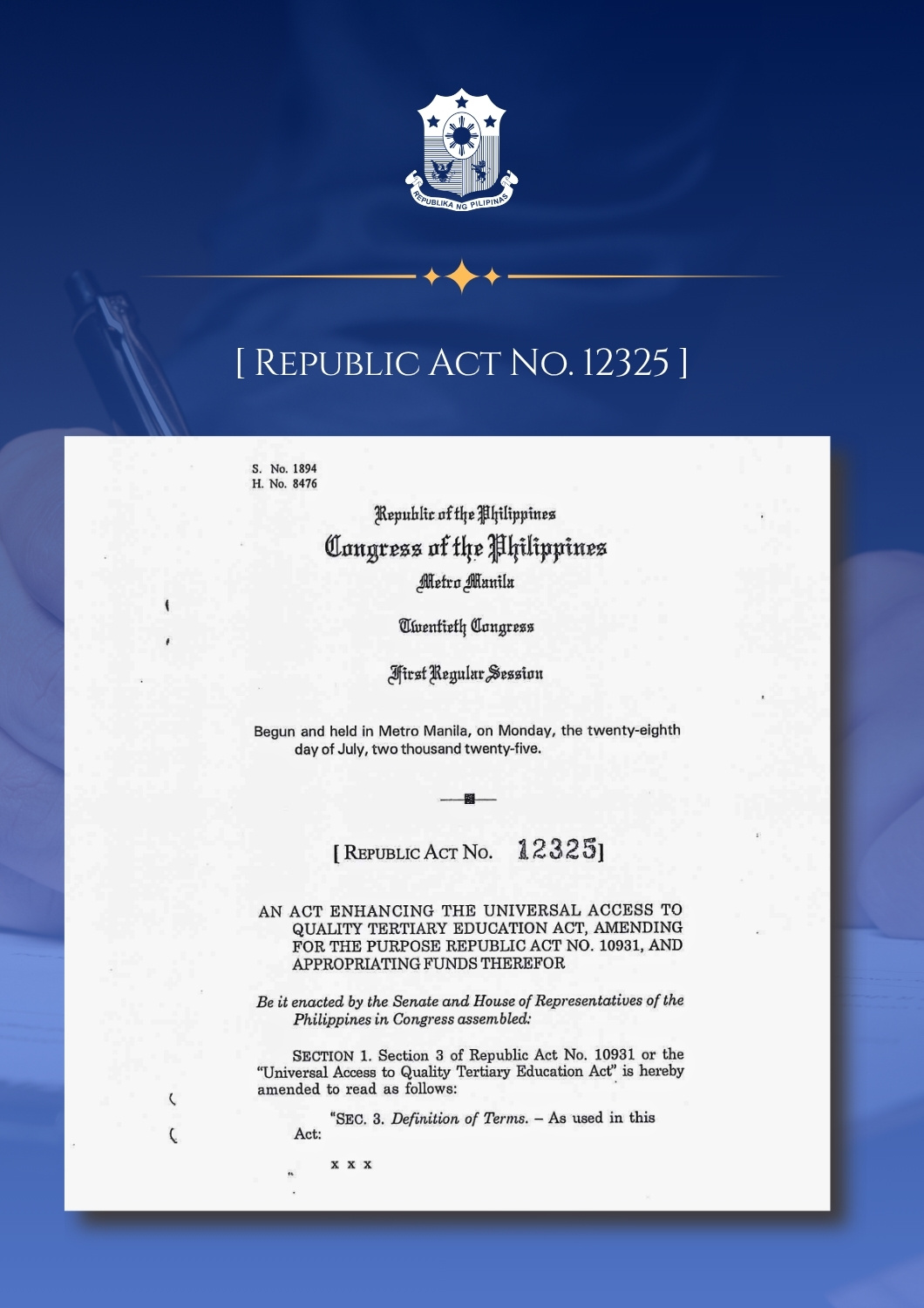
STUDETS from economically disadvantaged households may soon receive government assistance to pursue college or technical-vocational education in private institutions following the signing of Republic Act No. 12325, which expands the country’s system of financial support for tertiary education.
President Ferdinand R. Marcos Jr. signed the law on Friday, strengthening the government’s Universal Access to Quality Tertiary Education program by allowing public funds to partially cover tuition and other school fees of qualified students enrolled in private higher education institutions (HEIs) and technical-vocational institutions (TVIs).
Under Section 7-B of the law, the Private Education Assistance (PEA) program will be established to promote greater complementarity between public and private education and provide disadvantaged learners with opportunities to enroll in priority programs recognized by the Commission on Higher Education (CHED) and the Technical Education and Skills Development Authority (TESDA).
The program will primarily benefit poor and deserving students, with eligibility determined by the Unified Student Financial Assistance System for Tertiary Education (UniFAST) Board.
Applicants will be ranked according to household per capita income based on the latest available data from the government’s official poverty assessment system. Other verifiable proof of income may also be considered under guidelines to be issued by the UniFAST Board.
Beneficiaries must likewise be enrolled in programs identified as priorities by CHED, TESDA and the Department of Education and Development (DEPDev).
The Second Congressional Commission on Education (EDCOM 2) said the new law strengthens the Universal Access to Quality Tertiary Education Act by improving the targeting of government assistance toward students who face greater financial and social barriers to obtaining a tertiary education.
Among those given priority under the law are students from Pantawid Pamilyang Pilipino Program (4Ps) households, persons with disabilities, indigenous peoples, solo parents and their dependents, first-generation tertiary students, and learners from geographically isolated and disadvantaged areas.
First-generation tertiary students are those who are the first in their immediate family to attend college or a university and whose parents or guardians have not completed a bachelor’s or college degree.
The law also provides for possible additional assistance to qualified Tertiary Education Subsidy (TES) beneficiaries, including support for internships, Related Learning Experience (RLE), and other education-related expenses faced by economically disadvantaged learners.
Private colleges, universities and technical-vocational institutions that wish to participate in the PEA program must meet quality standards set by the UniFAST Board. These may include program accreditation, licensure examination performance, school facilities and other quality assurance requirements.
The UniFAST Board is also mandated to determine the average cost of tertiary education in eligible private institutions. The resulting study will serve as the basis for setting the amount of assistance to be provided to qualified students.
The financial assistance levels will be reviewed every two years to account for inflation and changes in education costs.
Before the program is implemented nationwide, CHED and TESDA, through the UniFAST Board, will conduct a pilot program lasting no more than three years, subject to the availability of government funds.
The measure, a consolidation of Senate Bill No. 1894 and House Bill No. 8476, was approved by both chambers of Congress before being signed by Senate President Sherwin Gatchalian and House Speaker Faustino Dy III on June 17 and June 3, 2026, respectively.
With the new law, government education assistance will no longer be focused primarily on public institutions, opening another pathway for qualified low-income students to pursue college and technical-vocational education in private schools.
About the Author