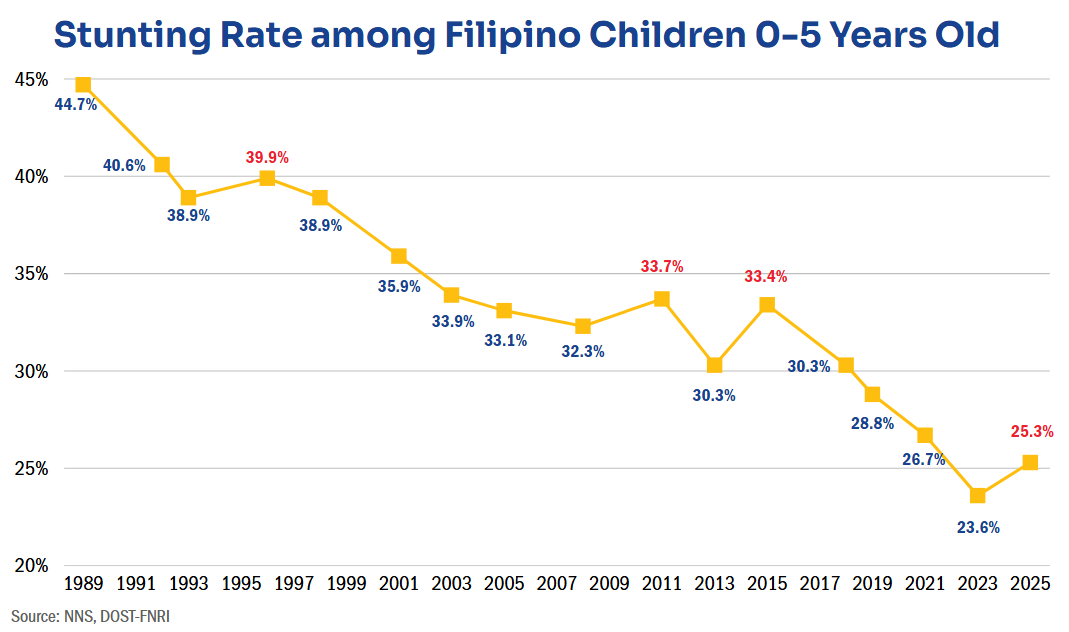
THE Second Congressional Commission on Education (EDCOM 2) expresses grave concern over the alarming findings of the 2025 Updating Survey Results released by the DOST-Food and Nutrition Research Institute (DOST-FNRI). The newly published data reveals that the stunting rate among under-five children, especially those aged 0 to 59 months, has reached 25.3%, equivalent to roughly one in four children. This represents a 1.7% increase from 2023 – the first jump in the country’s stunting rate since 2015.
This worsening nutritional status is officially classified as a “high public health concern”. The findings underscore what EDCOM 2 has consistently highlighted: that the country’s education crisis begins long before children enter the classroom. In its studies on Early Childhood Care and Development, the Commission has emphasized that malnutrition in the earliest years of life severely impairs cognitive development, language acquisition, and readiness to learn. Stunting remains one of the strongest predictors of poor educational outcomes later in life.
The 2025 Updating Survey, historically conducted every 2-3 years, was carried out from April 23, 2025, to March 31, 2026, successfully covering 91.5% of the targeted households across all 118 provinces and highly urbanized cities.
The survey results exposes stark disparities, showing that the most vulnerable populations are bearing the brunt of the crisis. Stunting rates are significantly higher in rural areas at 27.8% compared to 23.2% in urban areas. Regionally, the numbers are even more devastating, with the highest stunting prevalences recorded in the Bangsamoro Autonomous Region in Muslim Mindanao at 36.0%, the Zamboanga Peninsula at 34.6%, the Negros Island Region at 30.9%, and MIMAROPA at 30.3%.
The effects of malnutrition extend well beyond early childhood. According to the DOST-FNRI report, stunting affects 18.9% of school-age children between 5 and 10 years old, and 21.4% of adolescents between 10 and 19 years old. Furthermore, 18.6% of school-age children are underweight, with prevalence rates soaring above 24% in regions like BARMM, Zamboanga Peninsula, MIMAROPA, and the Bicol Region.
These findings come at a critical time for the education sector. EDCOM 2’s research has repeatedly shown that children who enter school malnourished face significant disadvantages in literacy, numeracy, and overall learning achievement. The Commission’s studies on the first 1,000 days and early childhood development demonstrate that nutritional deprivation in the early years has lasting consequences that are difficult and costly to reverse later in life.
The survey also highlights the underlying drivers of the crisis. About three in ten individuals, or 32.6%, experience moderate-to-severe food insecurity. To cope, 64.9% of food-insecure households are forced to purchase food on credit, particularly from sari-sari stores, and 68.6% rely on loans from relatives just to make ends meet. Maternal health risks further compound the issue, as 16.7% of pregnant women are nutritionally at-risk, making them highly susceptible to pregnancy complications and delivering low-birth-weight infants. This risk skyrockets to a staggering 40.0% among pregnant adolescents under the age of 20.
“The increase in stunting after a decade of decline should serve as a wake-up call for all of us. We cannot remediate in Grade 3 what was neglected in the first three years of life. If we are serious about solving the learning crisis, we must start by solving the nutrition crisis,” said EDCOM 2 Co-Chairperson Rep. Roman Romulo, as a principal author of House Bill No. 9466 amending the Masustansyang Pagkain Para Sa Batang Pilipino Act.
EDCOM 2 emphasized that no education reform can succeed if children arrive in school hungry, undernourished, and unable to reach their full developmental potential. The Commission reiterated its call for stronger coordination among government agencies responsible for nutrition, health, education, and social protection, and local government units at the frontlines of service-delivery, alongside sustained investments in maternal health, the first 1,000 days, early childhood care and development, and household food security.
As the country works to recover from years of learning loss and improve educational outcomes, EDCOM 2 stressed that addressing child malnutrition must be treated not only as a health imperative, but as an education reform.
About the Author