THE Second Congressional Commission on Education (EDCOM 2) calls on the Department of Education (DepEd) to ensure the strong link and progression between the early childhood care and development (ECCD) curriculum in child development centers and daycares, to its own Kindergarten, and Grade 1 curriculum.
Under the recently passed Republic Act No. 12199, or the ECCD System Act, the DepEd Secretary serves as Co-Chairperson of the ECCD Council for the ECCD Curriculum and all matters related to early childhood education. The law also makes DepEd responsible for children aged five to eight and directs it to recognize early childhood education as the foundation of the learning continuum. This is to address the current challenge faced by students wherein there is no clear progression between what is taught in daycares, and what is later learned in school.
The call follows data showing that as much as 75% of Grade 1 learners begin the school year as “struggling readers”, based on DepEd’s Comprehensive Rapid Literacy Assessment for the start of School Year 2026–2027. This leaves Grades 2 and 3 to carry the work of catching up before learners move on to Key Stage 2, where reading gaps widen sharply.
The recommendations emerged from Global Evidence, Local Action, an EDCOM 2 Brown Bag Session on early childhood development and foundational literacy held on 29 October 2026 at the UP BGC Campus, in partnership with Khan Academy Philippines, with Dr. Nonie K. Lesaux, Dean of the Harvard Graduate School of Education (HGSE), as resource speaker.
Most children start school without early learning
While more than 90 percent of Filipino children enroll in Kindergarten, only 34% percent of children aged three to four access early childhood education (APIS, 2024). DILG data shows that 4,604 barangays still have no child development center. At the start of this school year, 45 percent of Grades 1 to 3 learners, or about 2.2 million children, were struggling readers.
The gains made so far are real but fragile. An independent evaluation presented by DepEd’s Monitoring and Evaluation Office found that the ARAL Program helped move an estimated 1.37 million learners out of struggling reader levels in its first year, yet the new school year again opened with a large share of early-grade learners behind.
On the Kindergarten curriculum: “Your dosage is likely just too low”
“My sense is that your dosage is likely just too low, given your goals and given what it takes to get to reading comprehension,” Dean Lesaux said. “This whole enterprise is in service of reading comprehension, not just foundational skills. We need to mount a much more intensive Kindergarten and first grade experience, both in time and in the intensity of the curriculum.”
She urged educators to raise the “cognitive press” from the earliest years. “Young children are very capable, and actually wired to learn about big ideas,” she said. “We have to stay age-appropriate but drive up cognitive press: the big ideas, the rich, active learning, right from the earliest days. What you’re doing is jumpstarting critical thinking.”
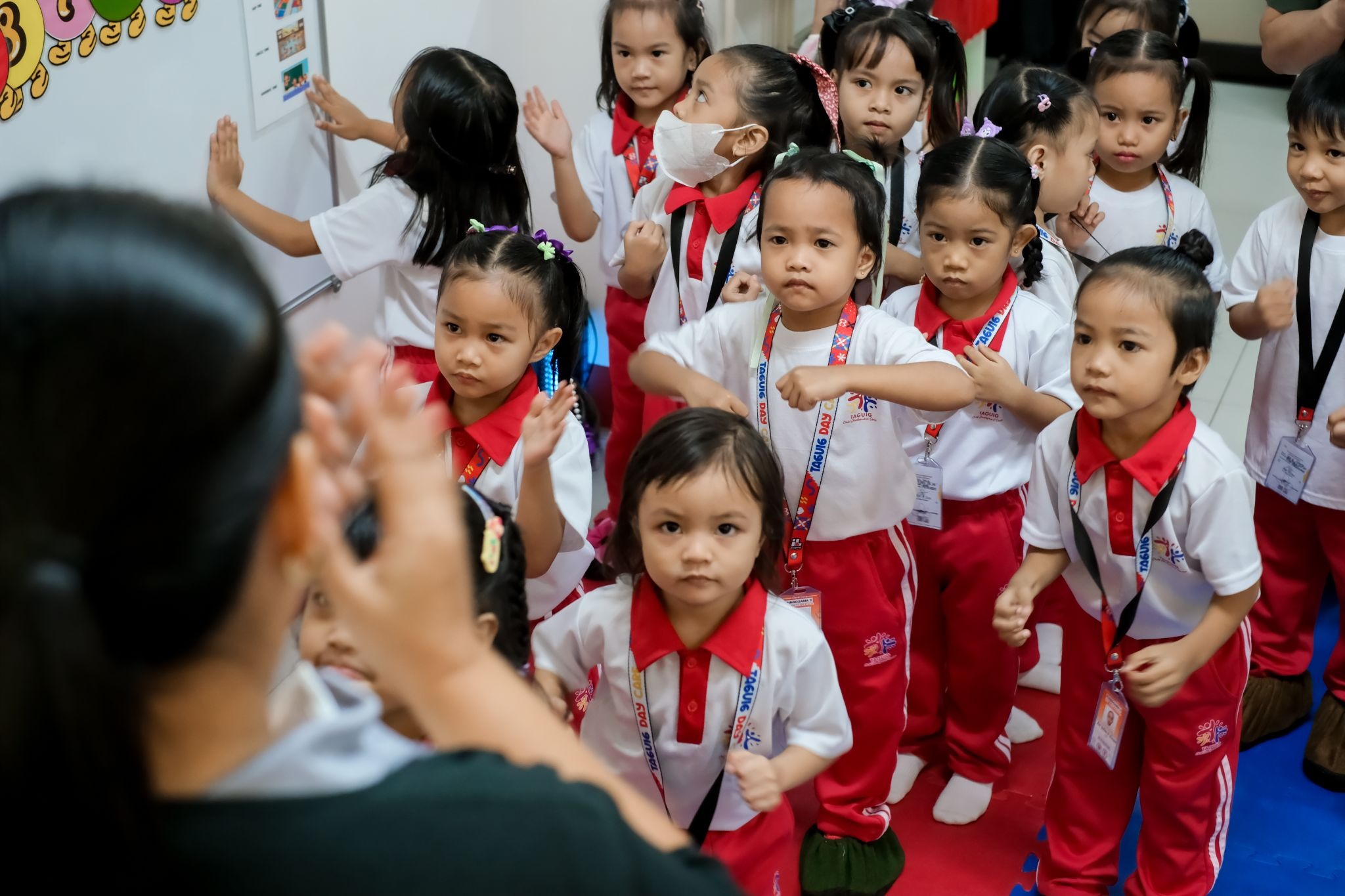
“Those three- and four-year-olds we saw this morning, they could really handle some big ideas and questions,” she said, referring to the visit to Pinagsama 1 Child Development Center in Taguig City, where she observed three- and four-year-olds during circle time, songs, and group activities.
This, she stressed, means deeper learning rather than more content. Welcoming EDCOM 2’s push to decongest early-grade competencies which DepEd has since implemented for Grades 1 to 3 under the revised curriculum last year, Dean Lesaux said: “You’re absolutely right to cut down on those competencies, and you could probably keep going. We could be doing 50 percent of what we’re doing, going deeper, and probably get somewhere better.” A strong early curriculum, she explained, is built around a few big ideas explored over several weeks, weaving literacy, numeracy, and science into hands-on activities.
She added that every strategy must pull three levers at once: assessment, professional learning, and curriculum and pedagogy. Systems that succeed need to connect pre-Kindergarten and Kindergarten curricula, keep familiar routines across grade levels, and train early childhood and Kindergarten teachers together, easing a transition that is often a moment of regression for young children.
A DepEd-led curriculum from daycare to Grade 3
Sen. Win Gatchalian said the disconnect begins with who sets the curriculum. “Right now, early childhood is run by local government units, and it’s largely the mayors who dictate what to teach. It’s not connected to DepEd,” he said. “Under our law now, DepEd has authority over the curriculum. The vision is that the entire Philippines will have a DepEd-led curriculum [for ECCD in daycares] that is connected to Kindergarten and elementary.”
Rep. Roman Romulo, EDCOM 2 Co-Chairperson, said the legal foundation is already in place under the ECCD System Act (Republic Act No. 12199), which professionalizes child development workers and strengthens local ECCD offices. “For us legislators, what comes next is oversight”, he said.
Dean Lesaux is the 13th dean of HGSE, the Roy E. Larsen Professor of Education and Human Development, and co-director of the Saul Zaentz Early Education Initiative. She has written extensively on improving early literacy for children across social and economic backgrounds and on strengthening policy for early childhood education, and received the US Presidential Early Career Award for Scientists and Engineers in 2008.
About the Author