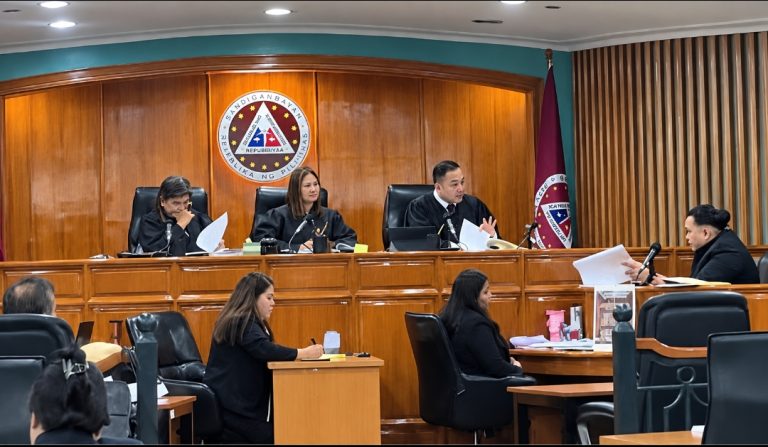
THE House Committee on Justice formally began deliberations on four impeachment complaints filed against Vice President Sara Duterte on Monday.
Panel chair Batangas Rep. Gerville “Jinky Bitrics” Luistro emphasized that the constitutional process must continue, despite political noise or public fatigue.
“Some have asked: Are we not tired of impeachment? Hindi ba tayo napapagod?” Luistro said in her opening statement. “But the answer is simple: The Constitution does not get tired. The rule of law does not get tired. Accountability does not get tired.”
Luistro said the committee was convening to discharge its “solemn constitutional duty” after the four complaints were simultaneously referred to the panel last week.
Under the Constitution, the justice committee has the exclusive mandate to hear impeachment complaints and, by majority vote of all its members, submit a report to the plenary.
“That mandate is not optional. It is not seasonal. It is not subject to fatigue. It is a duty,” she said.
“Walang palusot. Hindi tayo maaaring umiwas. Hindi maaaring umurong. Hindi maaaring magbulag-bulagan,” she added.
Luistro also rejected claims circulating on social media that the complaints merely recycle allegations supposedly dismissed by the Supreme Court.
She clarified that the high court’s earlier ruling was limited to the constitutional one-year bar rule and did not pass upon the merits of the allegations.
“The Supreme Court did not rule on the merits of the allegations. It did not conduct a trial. It did not weigh evidence. It did not absolve anyone of wrongdoing,” Luistro said, noting that the high tribunal itself emphasized it did not clear the Vice President of the charges.
“To suggest, therefore, that the allegations have already been resolved on the merits is legally incorrect,” Luistro added.
She underscored that impeachment is a constitutional mechanism, not a political contest.
“Impeachment is a constitutional process—not a social media contest. Hindi hashtag ang magpapasya dito. Hindi meme ang maghahatol. Hindi ito paramihan ng like,” she said.
Luistro said the committee would first determine the sufficiency in form of each complaint, clarifying that at this stage, members are not weighing evidence or determining guilt.
“We are simply asking procedural questions: Are the complaints properly verified? Do they comply with the requirements under the Constitution and the Rules of the House on Impeachment? Are they properly endorsed? Do they meet the formal thresholds required to proceed?” she said.
If found sufficient in form, the committee will proceed in subsequent hearings to determine sufficiency in substance, or whether the allegations, if assumed true and credible on their face, constitute impeachable offenses.
“In other words, impeachment cannot be built on rumor. It must stand on allegations that are serious, specific, and constitutionally anchored,” Luistro said.
She assured the complainants, the Vice President, and the general public that the process would be conducted fairly and transparently.
“We owe that to the complainants, whose claims will be scrutinized. We owe that to the Vice President, who will have the chance to respond and clear her name. We owe that to the Filipino people, who have a right to know the truth, to see justice done, and to hold their leaders accountable,” Luistro said.
“Let me say this clearly: No one is above the Constitution. Not the President. Not the Vice President. Not the Senate. Not the House of Representatives,” she continued.
Luistro then formally declared the committee in session to determine the sufficiency in form of all four impeachment complaints.
“Let the record show that we proceed not in anger, not in haste, but in fidelity to the Constitution and to the sovereign Filipino people,” she said.
About the Author