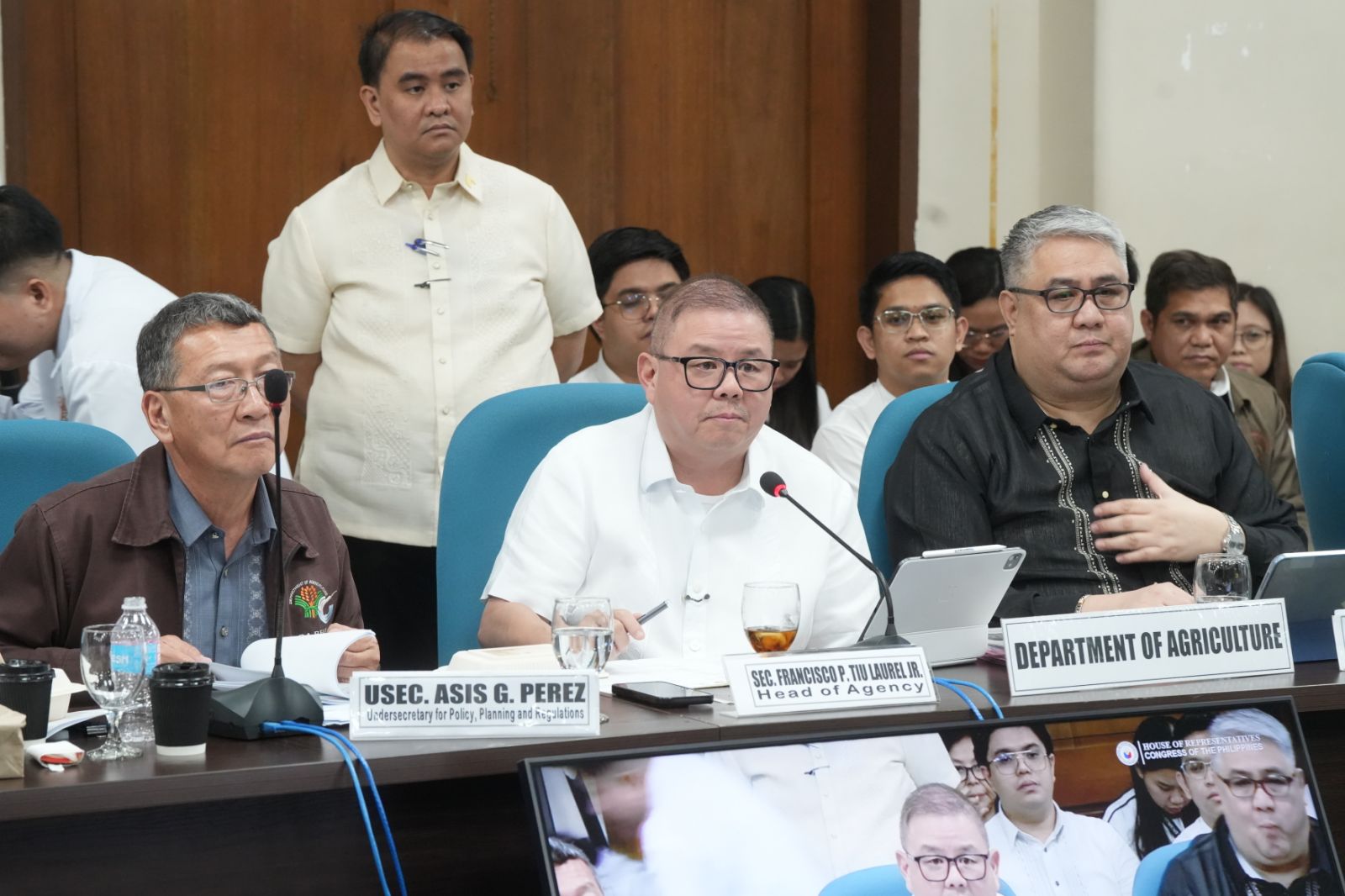
THE House Committee on Appropriations on Monday wrapped up deliberations on the proposed ₱176.7-billion budget of the Department of Agriculture (DA) and its attached agencies for 2026, which also covers the ₱45.07-billion allocation of the National Irrigation Administration (NIA) under the National Expenditure Program (NEP).
DA’ s proposed 2026 budget is higher by P21.14 billion or 13.59% from the 2025 General Appropriations Act (GAA), while NIA’s budget for next year was cut to P46.17 billion, lower than the P70.37 billion in 2025.
Committee chairperson and Nueva Ecija Rep. Mikaela Angela Suansing said the DA’s allocation includes P29.9 billion for the National Rice Program, P30 billion for the Rice Competitiveness Enhancement Fund (RCEF), P10 billion for the Rice for All program and P11.2 billion for buffer stocking.
She added P43.9 billion will fund programs in corn, high-value crops, organic farming, livestock and fisheries, P16 billion for farm-to-market roads, and P10 billion for the Philippine Rural Development Project, including mechanization, digital agriculture, food hubs and credit support.
“These programs represent an action plan for doable strategies to lower food prices, boost productivity, and ensure sufficiency across all staple commodities,” Suansing stressed.
She also highlighted NIA as “equally critical,” to develop 8,620 hectares of new service areas, restore 6,319 hectares and repair 533 kilometers of canals.
Agriculture Secretary Francisco Tiu-Laurel Jr. said DA’s budget is anchored on five pillars — boosting productivity, modernizing operations, strengthening value chains, expanding market access and protecting livelihoods.
However, DA Undersecretary Asis Perez reported declines in productivity, with palay output falling from 20.06 million metric tons in 2023 to 19.9 million in 2024, and corn from 8.421 million to 8.14 million metric tons.
“Looking at our performance from 2004 to 2024, the agriculture sector has not really grown, and this is the reality. It’s almost the same, stagnant. Our contribution is down from 15% in 2004 to 7.5% in 2024,” Perez said.
He also noted that while the Philippines reduced poverty incidence from 45.2% in 1991 to 15.5% in 2023 after joining the World Trade Organization (WTO), the pace was far slower compared to other Asian neighbors.
Vietnam cut its poverty rate from 70% in the 1990s to 4.4% in 2021, while Thailand brought its rate down from 58% to 6.8% in 2020. Moreover, as of June 2025, nearly 10.9 million Filipinos, or 20.9% of the workforce, are employed in agriculture and fisheries, earning an average of only P354.68 a day, keeping farmers and fisherfolk among the country’s poorest sectors.
Lawmakers pressed DA officials on irrigation, with PHILRECA Rep. Presley De Jesus asking if the country remains rice competitive.
“Sa irrigated areas we are very competitive. Ang problema talaga natin is unirrigated ang karamihan. Ang Vietnam is almost 90% irrigated, ang Pilipinas is only 46% irrigated sa flatlands,” Tiu said.
“If we can irrigate another 1.2 million hectares and average 5.5 to 6 metric tons per hectare, then we will be self-sufficient,” he added.
NIA Administrator Eduardo Guillen said their P214 billion request for 2026 was cut to P46.17 billion, which could greatly affect their irrigation projects and repairs that need urgent funding and implementation.
As of December 2024, irrigation development stood at 70% or 2.18 million hectares, with 1.02 million hectares still to be covered, but service delivery remains hampered by damaged dams, unlined canals and non-functional systems, with only P15.731 billion allotted.
Guillen added that NIA also plans 19 new and ongoing projects but of the P29.737 billion sought, only P4.981 billion was approved.
Catanduanes Rep. Eulogio Rodriguez, FPJ Panday Bayanihan Party-list Rep. Brian Poe and other lawmakers also raised the P20 per kilo rice target.
Tiu said the country is at par with Thailand and Malaysia when it comes to the price of rice, stressing that lower rice prices are possible with full irrigation, mechanization and post-harvest facilities, as key investments.
He also urged the repeal or amendment of the Rice Tariffication Law to allow control over agricultural importation while ensuring farmers earn a decent income.
About the Author