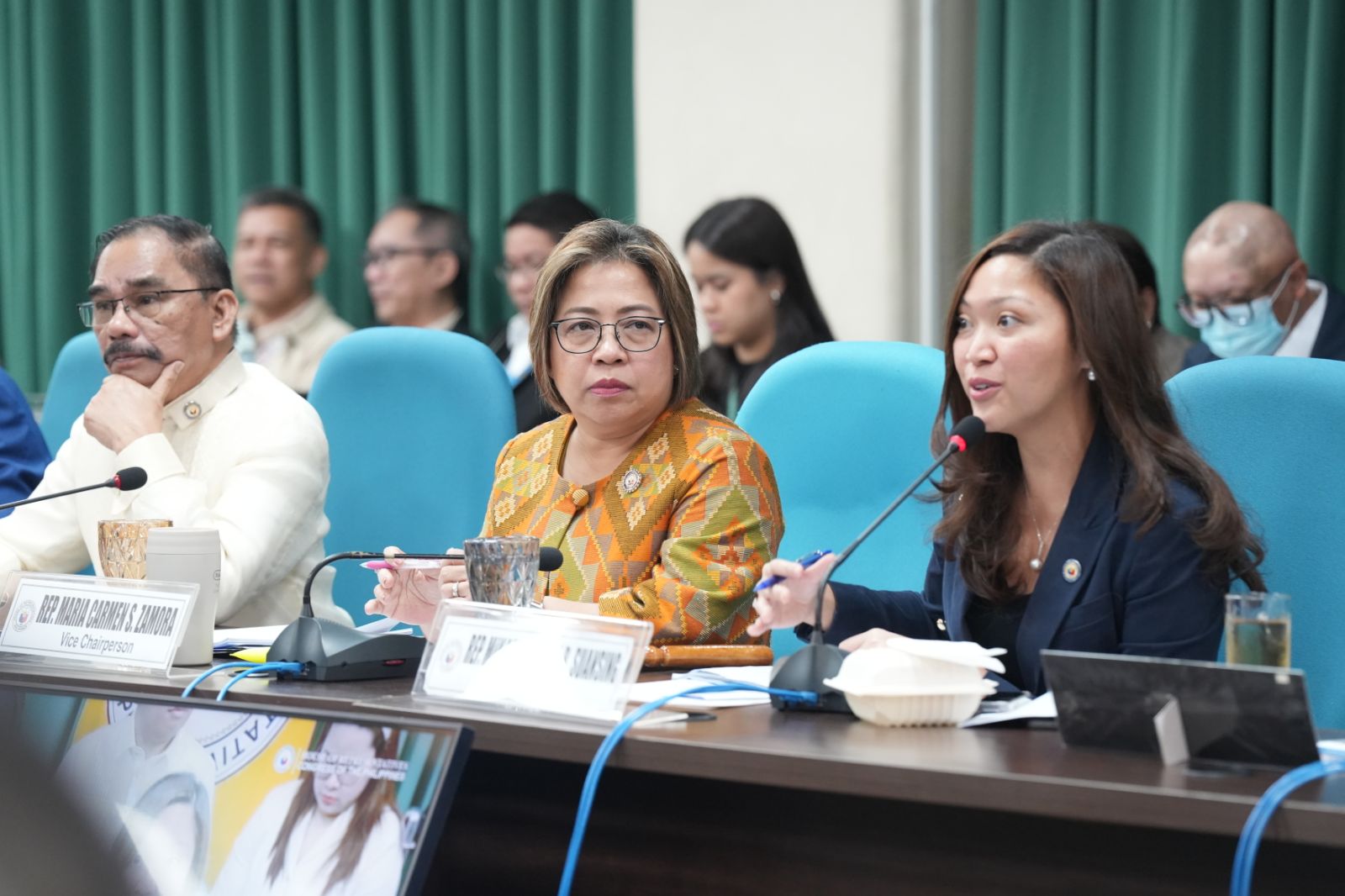
THE House Committee on Appropriations, chaired by Nueva Ecija Rep. Mikaela Angela Suansing, on Wednesday approved the proposed ₱928.52-billion budget of the Department of Education (DepEd) for fiscal year 2026.
The committee deliberated for seven and a half hours before terminating the budget hearing. Suansing highlighted that the allocation aligns with UNESCO’s recommended education spending level of ₱1.224 trillion, which includes DepEd’s proposed funding—equivalent to 4 percent of the country’s Gross Domestic Product (GDP).
“This proposed budget presents a vital opportunity to address persistent challenges and advances long overdue reforms in the education sector by directing substantial resources to where they matter most — our teachers, our learners and the learning environments that shape their future,” she said.
House Deputy Majority Leader and Tingog Party-list Rep. Jude Acidre raised that one-third of the 932,000 teachers in the country still hold Teacher 1 position despite their long years of service. He queried if the P2.9 billion allotted next year for human resource development would help in the promotion of these teachers.
“Pursuant to career progression, which you and EDCOM have been advocating for robust implementation, next year we will be promoting or reclassifying 142,000 of these 300,000 teachers. That is not only a recognition of their talents but it also means pecuniary benefit as well,” Angara said.
The move is also pursuant to the commitment of President Marcos that no teacher should retire with Teacher 1 position.
Assistant Majority Leader and Batangas Rep. Ryan Recto asked how the DepEd’s Public Private Partnership (PPP) partners for the construction of 105,000 public school classrooms are chosen.
Angara clarified that the construction of 105,000 additional classrooms under PPP is still a proposal.
“May regulatory stages pa yun. Given the amount of time needed to prepare the feasibility study, and the regulatory hurdles, next year na natin makikita ung signing of contracts and actual groundbreaking for these 105,000 classrooms. It will come in three packages — 15, 40 and 50 (classrooms) and we are committed to learn from previous PPPs wherein there were a lot of failed biddings, abandoned contracts because of the difficulty as many of these were in the remote areas and Last Mile Schools. We want to make it attractive para wala ng failed biddings dito,” he said.
Recto also queried about how DepEd harnesses Artificial Intelligence to address persistent challenges in education.
Angara said that last December, DepEd launched the Education Center for Artificial Intelligence Research or E-CARE, which is composed of some of the brightest AI scientists in the Philippines to incorporate AI.
He expressed the belief that AI will have a huge impact on the education sphere, the way it is impacting on businesses, organizations and jobs worldwide. From an organizational and efficiency standpoint, he said DepEd uses AI to manage its huge data sets which are not as robust or complete as they should be.
“We are still in the pre-analysis stage with some data sets. For data sets which are complete, we use these to see how we can decongest schools using the voucher program , Like if we take one school division, we can map out the crowded public schools and see the private schools that have overcapacity,” Angara said.
On the DepEd’s feeding program, he said AI can also be helpful in determining statistical certainty especially on the weight of children to check whether they are stunted or wasted. He said the use of AI will enable teachers to save time and focus more on learning just like what the President had wanted.
Committee Vice Chair Ma. Carmen Zamora sponsored the DepEd budget proposal.
About the Author