THE Second Congressional Commission on Education (EDCOM 2) today presented critical findings on the pervasive issue of child malnutrition and significant policy gaps in the Philippines during a hearing of the Senate Committee on Basic Education, chaired by EDCOM 2 Co-Chairperson Senator Bam Aquino.
Aquino emphasized the country’s long history in tackling stunting and malnutrition: “Sa loob ng 20 taon, hindi pa rin nabibigyan ng solusyon ang problema ng stunting sa ating kabataan…26.7% of Filipino children under five years old are stunted. Ibig sabihin, isa sa apat na kabataan ay hindi na matatamo ang kanilang tunay na potensyal”.
“Sa pitong taong lumipas, ang budget para sa implementasyon ng batas ay hindi nadagdagan, at hindi rin nabigyan ng solusyon ang stunting”, Aquino added.
During the hearing, the Commission underscored policy gaps in the current laws on nutrition. While the First 1,000 Days law covers children zero to two, Republic Act No. 11037, known as the “Masustansyang Pagkain Para Sa Batang Pilipino Act” on the other hand covers children from three to five, and up to Grade 6. This leaves behind children aged two to three, during which stunting occurs.
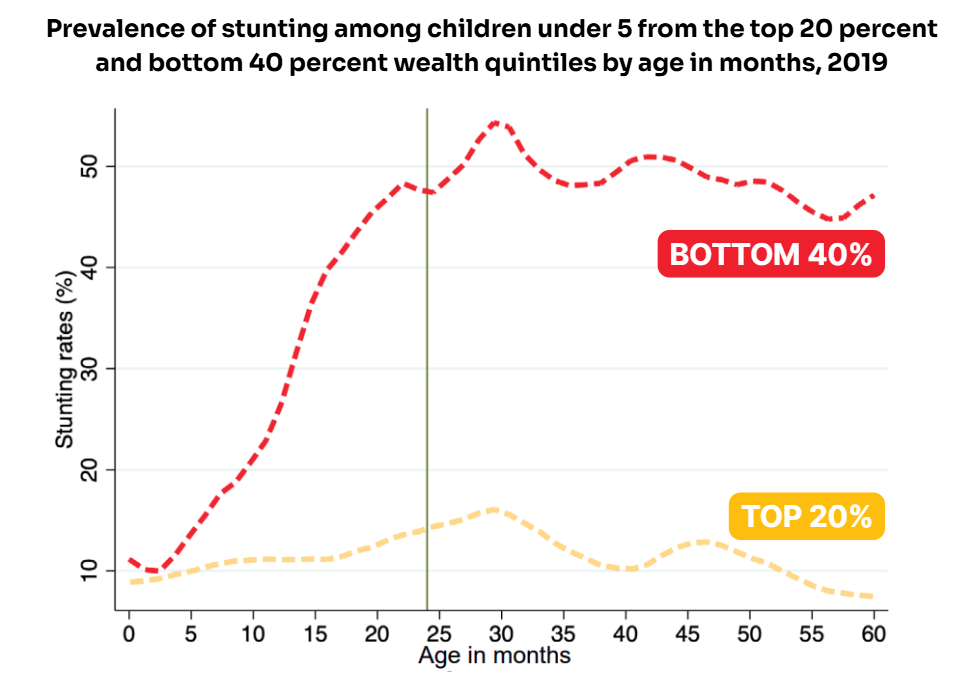
“Data shows that stunting occurs from 5 months of age and worsens up to 25 months. This means that stunting occurs in the First 1,000 days of life and needs to be addressed at the earliest years during which we are least invested,” explained Dr. Karol Mark Yee, EDCOM Executive Director. “By the time our children reach 25 months of age, stunting prevalence rises to up to 42% for the poorest, and 11% for the richest. We thus commend the efforts of the Committee on Basic Education to amend the law to include our children aged 2-3.”
Need to expand RA 11037 to cover children aged 2-3
Children who experienced stunted growth at age 2 exhibit poorer educational outcomes, directly impacting literacy rates and contributing to low PISA scores. Addressing these educational challenges is unattainable without first tackling stunting, as it lays the foundation for future learning. The data further highlights that only a quarter of Filipino children meet the recommended energy intake, with most suffering from severe deficiencies in protein and fat. Specifically, Filipino children aged 3-5 consume 20% less protein, 40% less fat, and 35% less carbohydrates than recommended, with children from the bottom 40% wealth quintile consuming significantly less protein, which is critical for growth and stunting prevention.
The Commission also noted alarmingly low participation rates in DSWD’s Supplemental Feeding Program (SFP), ranging from 10%-30% across regions, and a PIDS study finding that participation in the national SFP does not consistently result in improved nutritional status. EDCOM II noted that while the law requires DSWD to cater to all malnourished children aged 3-5, DSWD only covers those enrolled in daycares and supervised neighborhood play programs based on DSWD Memorandum Circular No. 26 s. 2024, leaving many children behind.
“The PIDS study finds that there are no differences in the nutritional status of children who participate in the DSWD SFP and those who do not. One factor is the low budget allocated for the program: from 2011 to 2024, the budget for hot meals per child was only at P15 pesos per day, and only recently increased to P25,” continued Yee.
Need to support 142,276 adolescent pregnant mothers in school
The Philippines faces one of the highest adolescent birth rates in ASEAN, with 500+ Filipino adolescent girls getting pregnant and giving birth every day. Babies born to adolescent mothers face higher risks of low birth weight, preterm birth, and severe neonatal conditions. While many of these young mothers are still enrolled in school, an estimated 142,276 adolescent pregnant mothers in DepEd schools cannot be served due to a limitation in RA 11037, which restricts SBFP coverage to undernourished public school children from kindergarten to grade six only.
“We cannot resolve our learning crisis without addressing our challenges in nutrition. We need to prioritize the first 1,000 days, and then children aged 2-4, and then focus on malnourished children in schools— not only looking at feeding, but also at holistic health interventions needed by children who keep falling back,” stated Yee. “We commend our EDCOM Commissioners, Sen. Bam and Sen. Win, for prioritizing the nutritional needs of our students.”
Aquino also expressed his optimism for reforms in the feeding program. “We have an opportunity to actually fund education in a big way this year…That’s also why I’m very optimistic na dito po sa amendments to the feeding law, mapopondohan po natin ‘to, especially this year”. EDCOM 2 Commissioner Sen. Win Gatchalian echoed his sentiment, emphasizing the opportunity to fund education priorities in the 2026 national budget. “Kahit papaano, mayroong light at the end of the tunnel…dahil magagamit na natin ang pondo para magbigay ng solusyon sa mahabang-mahabang problema na nakikita natin sa classrooms, nutritions, at health”, he said.
EDCOM 2 has partnered with the Philippine Institute for Development Studies (PIDS), to tackle nutrition and feeding issues hounding the education sector in the country. The study, entitled may be accessed here: Behind the Slow Start: An Assessment of Early Childhood Care and Development in the Philippines. An update to this study was published in July 2025 on the PIDS website. Additional studies on the next 1,000 days and opportunities to address undernutrition may be found here and here.
Executive Director Yee commended the efforts to fill in the gaps in the government’s feeding program. “We commend the rigorous efforts to amend the Masustansiyang Pagkain Para Sa Batang Pilipino Act. The identified gaps, from the overlooked 2-year-olds to the critical nutritional needs of adolescent mothers and the need for more impactful program implementation, are now at the forefront of our discussions. This collaborative focus on refining our feeding programs is vital, and we are hopeful that these strategic adjustments will lead to a truly comprehensive and effective approach to securing our children’s future through better nutrition”, he said.
About the Author