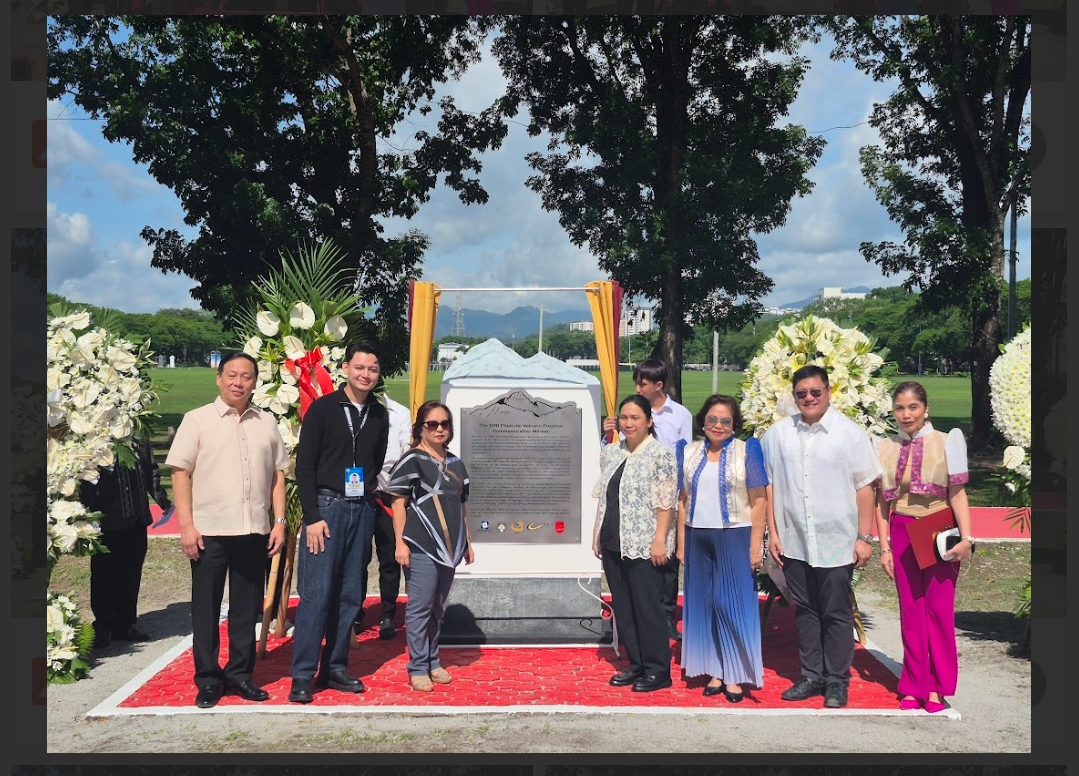
A COMMEMORATIVE marker honoring the 1991 eruption of Mt. Pinatubo was unveiled at the Clark Parade Grounds, marking the 35th anniversary of one of the most defining natural disasters in Philippine history and highlighting a shared story of resilience, recovery, and regional transformation.
The marker was jointly initiated by the Holy Angel University– Center for Kapampangan Studies (HAU-CKS), the Clark Development Corporation (CDC), the Department of Science and Technology–Philippine Institute of Volcanology and Seismology (DOST-PHIVOLCS), and Mekeni Food Corporation, which represented the business sector of Central Luzon during the ceremonial unveiling.
Former President Gloria Macapagal-Arroyo led the guests of honor, alongside CDC President and CEO Agnes VST Devanadera, representatives from the local governments of Angeles City and Mabalacat City, and partners from academia, science, and the private sector.
Mekeni Food Corporation President Pruds Garcia represented the business community, underscoring how the Pinatubo eruption reshaped not only the landscape of Central Luzon but also the trajectory of businesses that would later become drivers of its recovery.
Founded as a small backyard enterprise in Pampanga, Mekeni was among the many local businesses severely affected by the eruption and its aftermath. However, the crisis also became a turning point that redefined its mission, transforming survival into service, and rebuilding into purpose-driven growth. From these beginnings, Mekeni evolved into a nationally recognized food manufacturing company, while maintaining deep roots in community development and regional pride.
In his statement, Garcia emphasized that the story of Mt. Pinatubo is inseparable from the story of Central Luzon’s resilience, noting that the disaster “became both a test and a catalyst” for businesses that chose to rebuild not only operations but also lives and communities.
Today’s unveiling of the commemorative marker serves as a collective remembrance of the eruption’s impact, while also recognizing the enduring legacy of recovery efforts that followed, anchored on collaboration between government, academia, science institutions, and the private sector.
Beyond remembrance, the initiative also highlights renewed opportunities for collaboration in heritage tourism, public education, and strategic communications, as Clark continues to position itself as a hub for history, innovation, and sustainable development.
For Mekeni, participation in the project reinforces its continuing commitment to be more than a business success story. It stands as a living example of how adversity can shape long-term purpose, where growth is measured not only in scale, but in contribution to community rebuilding and regional identity.
As Central Luzon reflects on 35 years since Mt. Pinatubo’s eruption, the commemorative marker stands as a lasting symbol: from the ashes of devastation rose a shared legacy of resilience, with stories like Mekeni’s serving as enduring proof that rebuilding can become a foundation for legacy.
About the Author