THE Second Congressional Commission on Education (EDCOM II) today underscored critical findings from the discussion paper, “Low Fertility, Ageing Buildings, and School Congestion in the Philippines: Tailwinds, Headwinds, and Some Policy Options”, released by the Philippine Institute of Development Studies.
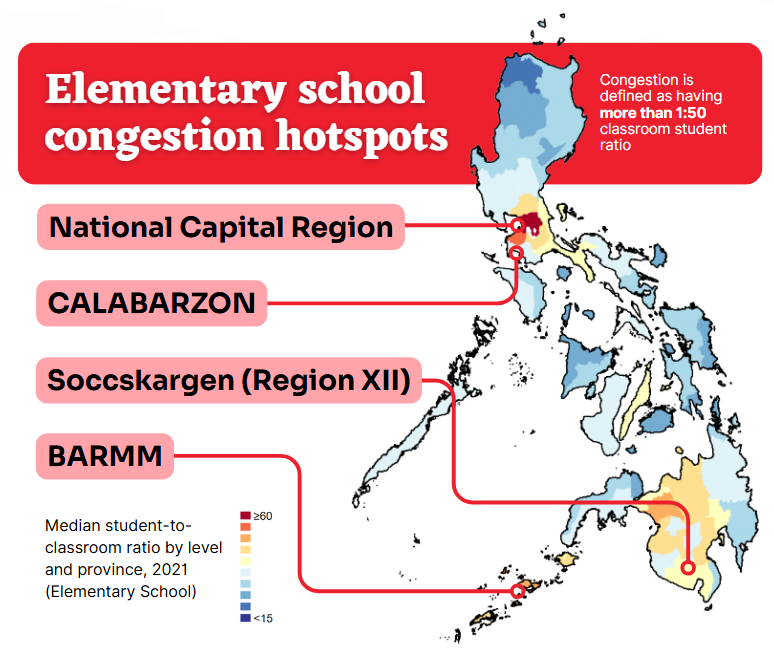
While the nation’s declining fertility rate offers a potential “tailwind” to ease classroom congestion, the study reveals that areas like the National Capital Region (NCR) andRegions 4A, 12 and BARMM, continue to face severe and persistent challenges from infrastructure backlogs and aging school buildings, demanding highly targeted interventions.
The paper, PIDS Discussion Paper Series No. 2025-10, released in June 2025, projects a general decline in total national public school enrollment across most regions until 2040, and potentially until 2060, driven by a reduced fertility rate. However, BARMM stands out as an exception, where the population of school-age children is projected to continue increasing, leading to increased public school enrollment.
The study provides a detailed spatial analysis of classroom congestion, highlighting that, in 2021, divisions within the NCR, Region IV-A, Region XII, and BARMM exhibited higher median student-classroom ratios in elementary compared to the rest of the country.
Meanwhile, in NCR, as much as 90 percent of public elementary school students in the Northern Manila District were enrolled in congested schools (with at least a 1:50 classroom-student ratio). This was closely followed by Southern Manila District, comprising the cities of Las Pinas, Makati, Muntinlupa, Paranaque, Pasay, Pateros, and Taguig (76.8%), Eastern Manila District, comprised of Mandaluyong, Marikina, Pasig, Quezon City, and San Juan (60.1%). Above-average levels of congestion were also observed in the provinces of Rizal (66.0%) and Cavite (57.7%).
The study also identified that the majority of the classroom deficit is concentrated on the elementary level, followed by junior high school and senior high school.
Projecting population growth rate data until 2040, the study finds that student-classroom ratios will remain highest in NCR and surrounding provinces for both elementary and secondary in the next 15 years. The same is expected in Cebu, Occidental Mindoro, BARMM, and Soccsksargen.
Even with fewer births, the Philippines could still lack 58,000 to 81,000 classrooms by 2040 if no new ones are built after 2021. The study highlights that while addressing congestion through school building programs is critical, the Department of Education (DepEd) must also factor in the wear and tear of existing buildings. Where, investments in new classrooms have often only been sufficient to replace dilapidated facilities rather than expanding the overall stock, thus failing to keep pace with enrollment increases.
A significant proportion of public school rooms are beyond their estimated useful life, with projections showing only 18.6 percent of 2023 public school rooms will remain in good condition by 2040 without new construction or repairs. The Philippines’ vulnerability to disasters also necessitates substantial repair or condemnation of school infrastructure, even newly built ones.
About the Author